Features
Lotto Palaver

My former classmate, Kwame Korkorti, told me recently that the symptoms of modern day diseases like unemployment and redeployment can effectively be stopped using herbal treatment. He also confided in me that if herbal treatment does not prove effective, then one needs to go the lotto way, to avoid weeping and gnashing of teeth.
Korkorti indeed has eleven and a half years practical experience in how to make ends meet. Although he was famous in the 70s as the best kpanlogo dancer of the decade, he was redeployed as a civil servant not too far back.
Faced with the dilemma of where to invest his redeployment benefits, he took the biggest risk in life. He used half the amount on lotto for four consecutive weeks and lost. He then approached a man called the ‘Lotto-Crocodile’ who gave him three sure tips, which were arrived at by the dictates of a ‘timing’ plan.
The calculations could not be doubted and the ‘crocodile’ was indeed revered, even feared, for his lotto prowess. Should Korkorti invest the other half of his benefits into the “3-sure” and damn the consequences?
If he lost, it would be a disaster for him. His wife would leave him, and the landlord would serve him with a ‘quit’ notice, and he would become a ‘Son of Man.’ Moreover, his friends would call him the biggest fool in contemporary times.
Investment
To be on the safer side, he told his wife about his investment plans. She flared up and called him an idiot and a fat-head John-Bull. Korkorti, therefore, recoiled into his shell but decided to stake just ¢1,000.
On Saturday, the three numbers were there in black and white. He promptly divorced his wife for having deprived him of millions of cedis.
Ever since this episode, Korkorti has become a lotto addict, a forecaster, a lotto magician, editor-in-chief of a lotto paper and the chairman of the Sikaman Lotto Winners Association (SLWA).
I heard there is also an association called the Sikaman Lotto Losers Association (SLLA).
Although it is the unemployed who are susceptible to the lotto syndrome, the business is also the pre-occupation of people from all walks of life-business executives, secretaries of state, assemblymen, fetish priests, pastors and evangelists, beggars and koose sellers.
In fact, lotto transcends all occupations and professions in such a way that both the rich and the poor are perpetually engaged in making money out of mechanised lotto, VAG-West or Lucky Scratch whose scarcity in the metropolis does not merit the numerous adverts on television.
Some people are born lucky and can win lotto 20 times in a year. Others like myself have been born to lose.
The last time I came close to winning was in 1983 when hunger in Sikaman was quite normal to the natives. It was the era of famine when man, wife and children had only one hard coconut for supper and got ready to develop jaundice. It was at that time that I got a “2-sure” tip from a very reliable but clandestine source. The mathematical solution of the problem was arrived at by permutation and combinations, backed by calculus and lotto matrices. The two numbers were unfailing.
I told two close friends about it and they staked heavily like I did. After I had kept the tickets safely in a notebook which l locked away in a fortified drawer, I quickly began figuring out a budget based upon the amount l’d win at the week-end.
I planned to purchase one maxi bag of rice, I’ll order yams from Kasoa, beans from Kordiabe and palm-nuts from Larteh. I’ll purchase a table top fridge (since l enjoy iced water so much), a portable sound system and a diplomatic shoe. I apportioned the amounts I’ll remit to my mother, my old-man, brothers, sisters and two friends.
I became so obsessed with this lotto palaver that I could hardly sleep at night. As the week-end approached, the excitement grew so much that I began feeling quite uncomfortable.
Come 5.05 p.m. on Saturday. My heart started beating violently when the Club Beer advert came clear on the air. It was only seconds away and I would be richest man in a time of scarcity and acute hunger. I dashed for my pen and paper.
The numbers were being mentioned by a deep-throated announcer: “And now, the numbers… “My heart beat like that of a marathon runner as I wrote them down, my fingers trembling. The first three numbers did not include my “2-sure” tips. But I was reassured when the fourth was one of mine.
I was ready to leap into air when the last number called was nowhere near my other number. I had lost, and immediately started thinking about where my supper would come from.
That was the day I vowed not to stake lotto again in my life. Lotto can be a good servant and also a bad master. It has been the fertile ground for some people and the downfall of luckless others. It has made some rich and also impoverished others. It has solved problems in families and caused problems in families.
Anyhow, it is the surest way of getting rich without getting into trouble with revolutionary laws. This is because with lotto, you can become an instant millionaire without dipping long fingers into public funds.
Some people say lotto is a vice. Well I do not consider it as such, but of course, it depends on the angle from which one views the game. Although I no longer stake lotto, I’ll be the last to advise anybody against it. It may be somebody’s saviour, who knows. Moreover, it is a way of taxing people for national revenue without, realising they being taxed.
In fact they pay the tax without force, and some gain therefrom. It has also been a source of employment for many, like lotto receivers and agents.
The only problem with lotto is that it is a time-wasting venture to which most workers concentrate all their attention instead of attending to official duties.
Productivity falls, because from the Managing Director to the cleaner, everybody is either busy calculating a certain mathematical progression or discussing the potency of a ‘machine’ number.
True to it, in an eight-hour working period per day, a typical lotto addict uses two hours to think about family problems, one hour for financial worries, and three hours to forecast winning numbers. The remaining two hours are shared between working on the job and relaxing. No country progresses with such work schedule.
Perhaps, it would be better if workers rely more on dream-numbers, car numbers and
house numbers instead of machine numbers, shadows, counterparts, addition 90, turning numbers and timing plans. We should not sacrifice productivity for personal gain. We are free to work lotto after closing hours, week-ends and public holidays. All the best in your lotto palaver.
This article was first published on Saturday, October 27, 1990.

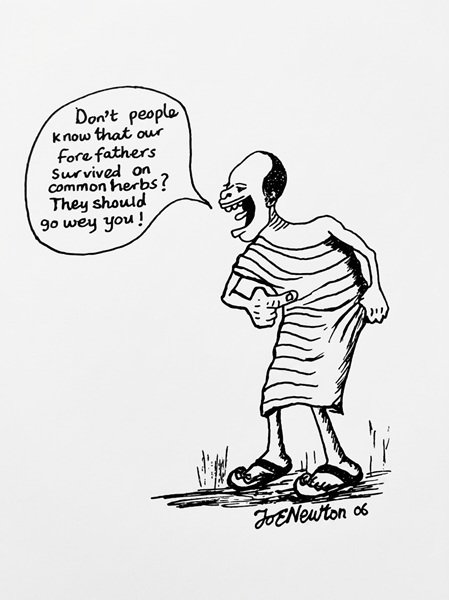
THE typical itinerant salesman in Sikaman is a herbalist. He is normally a slim macho with the capacity to perambulate the expanse of area covering the triangle of Accra-Tema-Ashiaman. In short, he can walk a total of 60 miles a day, marketing a product that cures every disease, including poverty. 
The door-to-door herbal pharmacist advertises his product by word of mouth. He has nothing to do with the Food and Drugs Board (FDB). After all, his concoctions do not feature on FM stations.
Those herbalists who cannot walk to propagate the herbal gospel, liaise with drivers of mass transportation and their mates. They are, therefore, given the chance to sell their products on Benz buses that ply the routes.
Normally, the herbalist starts his sales message with a prayer and Bible study. He asks the passengers to bow down their heads in supplication to God the father, the son, the Holy Spirit.
When a herbalist asks the passengers to close their eyes and bow their heads, Moslems on board naturally feel offended. They feel that the herbalist has no right to assume that every passenger is a Christian. They think such an assumption is an affront to Islam.
So a Moslem on board will raise the hand for a point of order. He’ll remind the herbalist that it would be in his own interest to mind his language.
“Be careful the way you address people in a public place. Not every person here is a Christian,” he’d state assertively.
Of course, the herbalist will promptly ignore him, but would all the same “watch” his tongue. Who knows whether or not the Moslem brother is inspired by Quoranic zeal to defend the tenets of Islam to the hilt?
When he starts saying, “Wallahi!” and “Inshallah!” it could be the beginning of proclaiming Islam as supreme, a point which must be driven home with talibanic precision.
So the herbalist must tread carefully lest he steps on fire.
The herbalist could even add a measure of mirth to it all, by announcing that Christians on board today have very interesting company on the journey, but that should not detract from the business of the day.
The Moslem brother will weigh the words carefully and offer a wry smile.
He must be careful the occasion does not degenerate into the use of semantics and proverbial oration to deride his conviction that public utterances must be mindful of religious sensibilities. He has made his point very clear and expects that it is taken in good faith in the interest of a peaceful journey.
The herbalist will now open the New Testament and preach salvation, stating clearly that salvation can come only through Jesus Christ and NOBODY else.
The Moslem brother will now start twitching his moustache. The visible and almost revolutionary reflexes of his upper lip can be an indication that sentiments have begun superseding reason, and the outcome could well be tragic now shift uneasily in his seat.
The time has come for him to also express his right to the religion of his fore-bears. He’ll put his hand into his pocket and rise to his feet. The time has indeed come!
This article was first published on Saturday, September 9, 2006
When the cause of a particular problem like sickness, disease, sudden illness, a social issue etc. are not known, it stands to reason that resolving it becomes a huge challenge.
Citizens would understand the government when public announcements are made to the effect that government is trying to find a solution to the issue, even though it is taking a while for it to be resolved because citizens are rational beings.
On the other hand, if the solution to a particular issue is known to everybody but the government for whatever reason, is dragging its feet in resolving it, citizens become frustrated and begin to lose trust in their leaders.
One such issue is the heavy traffic along a section of the Kasoa – Odokor road. A short stretch of bad road between the traffic light at the Weija Government Hospital and the entrance to the entrance of the overhead that leads to the N1, is the cause of the problem but nothing is being done about it, day after day, week after week, month after month. Thus is clearly unacceptable.
Another issue that requires urgent attention is the lack of pavements along a lot of streets in parts of the various Municipal Assemblies. Exercise is a prerequisite for long life and healthy living and for those of us who it has become a way of life, this issue of people putting up structures right to the edge of the drains beside the roads, are making life difficult for us.
We are compelled to walk along the roads, putting our lives at serious risk. Pedestrians should never be compelled to compete with vehicles on our streets and roads. Roads and streets are made for vehicles and pavements are made for pedestrians. That is the norm. Any attempt to normalise a situation where pedestrians are mingling with vehicles is insanity.
It is the road regulations that makes it so and therefore district or municipal assemblies are to take responsibility and ensure that spaces for pavements are not encroached upon. Citizens have rights that must be protected by their leaders and making pavements available to pedestrians, is one of them.
When we hear of teachers having sex with students, it appears it is something recent. It is not a new phenomenon. It has been there since Adam. Perhaps this issue is getting much attention due to the proliferation of social media. It was an open secret in times past when Teachers were in relationships with female students and some married them immediately after completion of school.
Some teachers were also known to be having unholy interactions with female pupils but due to the times that these acts occurred, human rights issues and the awareness around it, allowed such unscrupulous teachers to get away with their crimes.
Now we are in a different era and so a Headmaster is now in hot waters. He is alleged to have raped about 19 female students and as usual, some officials tried to cover it up and are also in hot waters and their actions or inactions in the matter are under investigation.
Why the man has been allowed to roam freely without being arrested is simply mind boggling. It appears that the law applies differently, depending on who you are. This issue came to public attention sometime in August this year, yet the police had not arrested or invited this man for question regarding the rape allegation.
It has come out that he is a Constituency Secretary of the ruling party and the question in the public domain is that, is it because he is a political figure that is why he is still walking around without questioning? I believe in the rule of law so let us hold our breadth and let the proper thing be done.
The police must however be seen to be active in this matter. God bless.
SKIP THE QUEUE, TAP THE NEWS
You can now read the Ghanaian Times and The Spectator newspapers from the comfort of your device via TimesNewsPlus.
Join our WhatsApp Channel: https://whatsapp.com/channel/0029VbBElzjInlqHhl1aTU27