Features
Fare thee well! Queen Elizabeth II of Great Britain

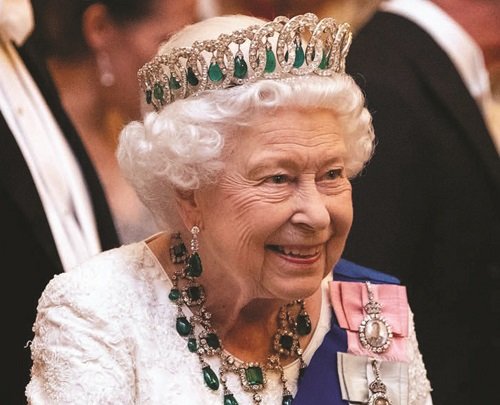
• The late Queen Elizabeth II
The sudden passing of Her Royal Majesty, Queen Elizabeth II of Great Britain, which sad event occurred on Thursday, September 8, 2022, at the hospital in London, struck the world with grief.
This is because Her Royal Majesty, Queen Elizabeth II issued appointment document to the new British Prime Minister, Liz Truss, on Wednesday, September 7, 2022, at the Buckingham Palace, at an impressive ceremony, only to join Her ancestors in the celestial realm the next day. Oh! What a sudden death! and a world of mysteries in which we live.
She represented the ‘soul’ of the people of not only Great Britain but the Commonwealth of Nations comprising former British colonies. Her reign of 70 years on the throne is the longest in the history of the British Monarch.
Her reign would go down in history as the period that saw the end of hundreds of years of British Colonial rule in certain parts of the world.
In West Africa, the British colonies were: The Gambia, Sierra Leone, Ghana and Nigeria then dubbed the four British Sister colonies of West Africa.
Ghana became the gateway for gaining Independence from British rule of over 100 years on Wednesday, March 6, 1957, followed by Nigeria and so forth.
Whilst on the throne, Her Majesty Queen Elizabeth made two significant Royal visits to Ghana on the invitation of the first President of Ghana, Osagyefo Dr Kwame Nkrumah of blessed memory. She visited Ghana on November 9 – 20, 1961, and again visited Ghana on the invitation of the President Jerry John Rawlings also of blessed memory, on November 7- 9, 1999.
The late Queen was not only beautiful and graceful by nature but, always appeared calm, humane and was a highly decent minded person. She was so free and made high profile visitors feel free and comfortable with her.
On one occasion, when Ghana’s first President, Osagyefo Dr. Kwame Nkrumah, visited London and welcoming him, the Queen in a joking manner asked President Nkrumah “whether the stick he often held was the source of his power” and President Nkrumah gracefully laughed. It increased the joy of their happy moments.
Ghana has always had very cordial diplomatic relationship with Britain all the years under the Queen of England. Let us hope it will continue even long after her passing and pray that the next person on the throne would similarly do well to help improve good relationship with Britain’s international allies everywhere in the world.
Readers, at this point, permit me to quote the Reggae music icon, Bob Marley of blessed memory, who declared on his last days on sick bed: “One thing I have realised is that not even money can be used to exchange death for life.”
It is an undeniable fact that many people including the poorest die in the world due to lack of fund. On the other hand, no amount of wealth or money could have been exchanged for the lives of prominent people in the likes of Nelsom Mandela, Dr Kwame Nkrumah, Jomo Kenyatta, Abraham Lincoln, Lady Diana, Margaret Thatcher, Prince Philip and Queen Elizabeth.
The people of the world loved you but the most High Father loves you the best. May Mother earth lie lightly on all of you as you rest peacefully and eternally until the resurrection day when we shall all meet again. Fare Thee Well.
Concerned Citizen
J.K Tetteh Kpodjie
C/0 Ebenezer Presby Church
P.O.Box 10, Somanya E/R
Phone 0557672086


The driver stopped the vehicle at the gate of the large, fenced property along the Nsawam Highway, and Kakraba stepped out to meet the several workers who had gathered to wait for him.
He greeted them and went straight to the point.
“Gentlemen, I am glad to see that you have almost completed the clearing of the land. I’m happy to report that we have concluded all arrangements with Nana Serebour, and construction of the palace will start in a few days.
“I will need you to go and level the ground, and then come back to start this project. Some workers from a construction company will come and join us.
“My plan is to build twenty houses in four months. Then we will do twenty more until we reach two hundred.
“I am relying on you to help me deliver good-quality work to satisfy our clients and, as I have already indicated to you, I will reward you for your work.”
After an hour’s discussion, he closed the meeting and moved to drive away. Wofa Yaw drew closer.
“Director, can you please spare me five minutes? I would like to discuss a small issue.”
“Why, Wofa Yaw? Your wife has threatened to leave you?”
“No, Director. My wife will never leave me. This concerns a young niece of mine.”
“I hope it’s something I can help with. Please sit in the car and let me hear you.”
“Boss, my niece, Beesiwa, is a polytechnic graduate, very beautiful and with very good character.
“Unfortunately, her parents virtually forced her into a relationship with an idiot based in the US, which affected her badly. She has now recovered from that experience and, Boss, I am respectfully asking if you would find a job for her.
“I promise you that you will never regret it.”
“Well, Wofa Yaw, let me meet her and speak with her. I may be able to help, maybe not in the way you expect, but let me meet her.
“I will not be back here for another week, but I will be at the office throughout next week. You can come with her.”
On Monday morning, Wofa Yaw and Beesiwa were seated at the office by nine o’clock. Three young ladies welcomed them warmly, offered them soft drinks and assured them that Kakraba would be there shortly.
They then returned to their desks and sat behind computers with large screens displaying various building designs.
Kakraba walked in and greeted them warmly. After chatting briefly with the three ladies, he ushered Wofa Yaw and Beesiwa into his office.
“Director, this is my niece, Beesiwa. I mentioned her to you when you came to Nsawam.”
“Yes, indeed. Madam Beesiwa, you are very beautiful, just as your uncle said. Wofa Yaw is my colleague.
“We have just started a building project that will take about three to four years. He mentioned that you have a small problem, so I said I would like to meet you and see how I can help.
“So, Beesiwa, please tell me a little about yourself.”
Beesiwa described her childhood, her school experience, her brief work at the bank and the nasty episode with Sammy Abrokwa, which shattered her peaceful life. She also explained how she had been recovering from the experience.
“I am really sorry to hear this,” Kakraba said. “Now, here is what we are going to do.
“We are a small but very busy company. The three ladies out there spend most of the day on site and come back to report on their work in the morning.
“I have three main projects. The big one is an estate project in Nsawam, where your uncle is one of my main colleagues. I need a personal assistant who can take care of my activities, especially when I am not in town.
“Now, we will have to start with trust. Based on what I know about Wofa Yaw, and based on what you yourself have told me, I think we can start on a sound basis.
“So, Wofa Yaw will take you to my home. You can move into one of the four guest rooms.”
“Sir, I have taken some computer lessons, and I have even done graphics and web design,” Beesiwa said.
“Fantastic! I will give you a good phone and a laptop. I will also arrange computer lessons for you.”
“Now, Wofa Yaw, take her home. My sister, Kuukuwa, will meet you and show you around, and then you can return to Koforidua.
“When would you like to start work?”
“Sir, I would like to start today, but I would need to go and bring my things.”
“No problem. Take a taxi to my house, meet my sister, and let me know what you decide.”
Later that day, Kakraba and the three ladies met with some bank officials to conclude the sale of the three buildings at Adabraka.
They closed at five-thirty and, after rewarding the ladies for their hard work, Kakraba got home just after dark.
He was surprised to find Kuukuwa and Beesiwa sitting at the table enjoying supper.
“What’s happening here?” he asked. “Beesiwa, I thought you would return to Koforidua.”
“She changed her mind,” Kuukuwa said. “We went to the mall and bought a few things for her. Then we came back to cook. She has made some nice changes to your bedroom and cooked a couple of interesting dishes. Sit down; we will serve you.”
“Well, I certainly can’t refuse that. It’s been a busy day.
“So, what’s the plan now? Will Beesiwa go to Koforidua tomorrow, gather her things together and come down?”
“No, I will stay here for a while,” Beesiwa replied. “Kuukuwa bought me the things I need, so I may go back next week. I’m ready to start work. What would you like me to start with?”
“Well, you can come to the office tomorrow morning, meet the three girls and get a feel for what we do.
“Since you are living here, at least for now, we can discuss the plans for the next few weeks.
“Sometimes there are gaps when I travel up north. You can take care of things from now. I think the girls would like having someone like you around.”
By Ekow de Heer
SKIP THE QUEUE, TAP THE NEWS

You can now read the Ghanaian Times and The Spectator newspapers from the comfort of your device via TimesNewsPlus.
Join our WhatsApp Channel: https://whatsapp.com/channel/0029VbBElzjInlqHhl1aTU27
A frequent question following breast surgery is whether human tissue possesses the regenerative capacity to restore an excised organ.
From a strict physiological standpoint, a completely removed breast cannot regrow. Unlike certain organisms that can regenerate complex limbs or organs, adult human tissues—particularly specialised glandular structures—lack the cellular machinery required to rebuild an entire organ after its total surgical removal.
Instead, the body heals the surgical site through processes such as scar tissue formation and re-epithelialisation rather than complete cellular regeneration.
What a mastectomy actually removes
To understand why natural tissue regeneration does not occur, it is important to examine the surgical scope of a mastectomy.
Depending on the type of procedure and the medical reason for surgery, a mastectomy may involve the removal of:
Glandular architecture: The milk-producing lobules and ducts that form the functional core of the mammary gland.
Adipose tissue: The fatty tissue that contributes to breast volume, projection and contour.
Other breast tissue: The extent of tissue removal varies according to the type of mastectomy and the need to achieve appropriate surgical clearance.
Because specialised breast structures are physically removed, the body does not rebuild a complete mammary gland. Instead, healing occurs through tissue repair and scar formation.
Distinguishing residual tissue from “regrowth”
Patients or observers may notice changes in the chest area after surgery, sometimes leading to misconceptions about tissue regeneration.
Skin- and nipple-sparing procedures
Modern breast surgery may preserve the outer skin envelope or, in selected cases, the nipple-areola complex. Small amounts of breast tissue may remain depending on the surgical technique. Any changes in remaining tissue due to hormonal fluctuations represent residual tissue responding to the body, rather than the regrowth of a completely removed breast.
Adipose accumulation
Weight gain after surgery can increase the amount of subcutaneous fat across the chest wall. However, this is part of general body fat distribution and does not represent the regeneration of a mammary gland.
Modern reconstructive pathways
Because a completely removed breast does not naturally regenerate, modern medicine offers reconstructive options aimed at restoring physical symmetry, contour and body image.
The two main approaches are implant-based reconstruction and autologous, or tissue-based, reconstruction.
Implant-based reconstruction
Implant-based reconstruction uses synthetic medical devices, typically filled with silicone gel or saline, to rebuild the breast mound following a mastectomy.
The two-stage process: This approach may begin with the placement of a temporary tissue expander to gradually create space and stretch the surrounding tissues. A later procedure may then be performed to place a permanent implant.
Recovery profile: Implant-based reconstruction generally involves a shorter initial surgery and recovery period compared with procedures that require tissue to be harvested from another part of the body.
Long-term considerations: Breast implants are not lifetime devices and require ongoing medical monitoring. Some patients may need additional procedures over time because of complications or changes in the implant or surrounding tissue.
Autologous or tissue-based reconstruction
Autologous reconstruction uses the patient’s own living tissue to create a new breast mound. Tissue may be transferred from another part of the body, commonly the lower abdomen, using procedures such as a DIEP flap.
Natural look and feel: Because the reconstruction uses living tissue, it can provide a natural warmth, texture and softness. The tissue may also change with the patient’s body weight over time.
Long-term durability: Once healing is complete, autologous reconstruction can provide a long-lasting result without the need to replace an implant. However, some patients may still require further procedures.
Complex surgery: This option usually involves a longer operation and recovery period. In microsurgical procedures, surgeons may need to reconnect tiny blood vessels to establish blood flow to the transferred tissue.
Direct comparison
When choosing between these two reconstructive pathways, patients and their surgical teams must consider several physical, medical and lifestyle factors.
Surgical burden: Implant surgery is generally less invasive, while flap reconstruction involves surgery at both the chest and the donor site.
Foreign material versus native tissue: Implants involve the use of a medical device, while autologous reconstruction uses the patient’s own tissue.
Recovery: The recovery timelines and rehabilitation requirements differ significantly between the two procedures.
Recovery and physical rehabilitation
Recovering from breast reconstruction requires patience, careful pacing and, in some cases, structured physical rehabilitation.
Because implant-based and autologous tissue-flap procedures involve different surgical techniques, their healing timelines and physical therapy milestones can vary considerably.
Understanding these differences is important for patients considering reconstruction, as the choice involves more than restoring physical appearance. It also requires careful consideration of recovery, long-term monitoring, lifestyle and individual medical needs.
Part 2 will examine recovery timelines, physical therapy milestones and other factors patients should consider when choosing between reconstructive options.
By Robert Ekow Grimmond-Thompson
SKIP THE QUEUE, TAP THE NEWS
You can now read the Ghanaian Times and The Spectator newspapers from the comfort of your device via TimesNewsPlus.
Join our WhatsApp Channel: https://whatsapp.com/channel/0029VbBElzjInlqHhl1aTU27