Hot!
Fact sheet about agric equipment in Ghana

- /home/u249204778/domains/spectator.com.gh/public_html/wp-content/plugins/mvp-social-buttons/mvp-social-buttons.php on line 27
https://spectator.com.gh/wp-content/uploads/2021/11/A-field-officer-uprooting-cassava-roots-with-improved-manual-cassava-harvester-1.png&description=Fact sheet about agric equipment in Ghana', 'pinterestShare', 'width=750,height=350'); return false;" title="Pin This Post">
- Share
- Tweet /home/u249204778/domains/spectator.com.gh/public_html/wp-content/plugins/mvp-social-buttons/mvp-social-buttons.php on line 72
https://spectator.com.gh/wp-content/uploads/2021/11/A-field-officer-uprooting-cassava-roots-with-improved-manual-cassava-harvester-1.png&description=Fact sheet about agric equipment in Ghana', 'pinterestShare', 'width=750,height=350'); return false;" title="Pin This Post">
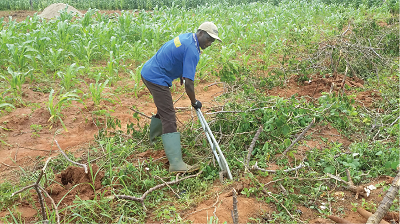
IT is interesting to note that: • Improved manual cassava harvester was released in 2017. Harvesting, one of the serious bottlenecks in the cassava production value chain, has received little attention in terms of mechanization. Earlier attempts at mechanising cassava harvesting have been challenged mainly by inappropriate method of planting, field topography and scale of cultivation.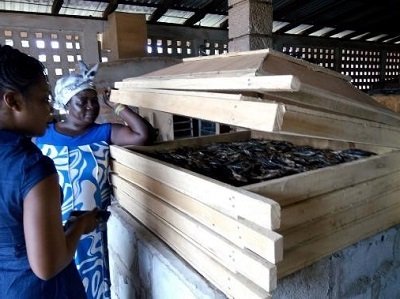

Developing and adopting simple but efficient energy-saving manual harvesting tools and equipment is a sure way forward in overcoming these challenges in cassava harvesting. The cassava harvesting tool was constructed with the idea of reducing drudgery due to waist bending associated with existing manual harvesting tools which usually leads to waist pains and other bodily weaknesses.
The equipment is suitable for all cassava growing ecologies in Ghana. The improved hand-held tool can harvest cassava twice as fast with half the effort required when using existing manual harvesting options. Farmers have increased their production area and yield by 15-25 per cent after being introduced to the harvester.
• Recirculating aquaculture technology was released in 2015. Simple raised tanks that can be set in the backyard with minimal skill requirement. This technology is an aquaculture system composed of a raised tank structure (rectangular, circular or ellipsoid) made of either a cement block or wooden frame and lined with a canvas material to make. It is applicable to all cassava growing parts of the country. It can be done in homes.
• New oven for smoking fish (AFSMO-150)/ Ahotor stove was released in 2007. A brick oven which reduces tar deposition on smoked fish with increased fish smoking capacity. Ahotor stove is applicable in all fishing communities in Ghana. It is less laborious to operate, has higher smoking capacity, it is more economical to use because it consumes less fuel, and it deposits less tar on the fish and, therefore, produces better quality smoked fish.
• Improved Chorkor smoker (AFSMO) was released in 2005. This technology is to help to reduce Poly-aromatic Hydrocarbons (PAHs) in smoked fish and reduce the drudgery involved in the other means of smoking fish. The use of fuel wood is reduced. Chorkor smoker is applicable in all fishing communities in Ghana. It reduces PAH in smoked fish which makes it healthy.
• Flash Dryer- drying of root crops cakes, was released in 2004. A typical flash-drying process consists of a modified pneumatic conveyor in which the wet solids are introduced. They go through a chute where they are transported in a high velocity hot air stream. Particles fall under high velocity and pressure through a cyclone (in some instances 2, 4 or 6 cyclones).
Thermal contact time between the conveying air and the solids is usually very short and, therefore, flash dryers are most suitable for removal of external moisture.
It is applicable in all parts of the country. Compared to solar drying (two days for drying) and cabinet drying (12-15hrs), flash dryer dries one ton of cassava (for example) in 1hr 30mins. Flash dryer dries in a flash. Flash Dryer is fast, and temperature build-up after an hour is enough to keep on drying without fuel. It can utilise either LPG or diesel in operating. Capacity is between 250- 500kg/ hr output 7. It requires little oversight after temperature build-up.
Source: Manual of Agricultural Technologies developed by CSIR, MAG and MoFA Page: 133-136



The Tema Regional Police Command has arrested a 32-year-old man for allegedly posing as a soldier and extorting money from unsuspecting members of the public at Ashaiman.
The suspect, identified as Bright Atsu Kudiabor, was arrested by the Ashaiman Police on Wednesday, September 16, 2026, at about 7:00 a.m.
According to the Police, he was arrested at an area known as “I Shall Return”, where he was allegedly parading himself as a soldier and demanding money from people.
The Police said Kudiabor, who is an ex-convict, was initially arrested by personnel of the Ghana National Fire Service in Ashaiman with assistance from other members of the public.
A search conducted on him after he was handed over to the Police reportedly led to the recovery of a set of military camouflage uniform.
The suspect is currently in Police custody and assisting with investigations.
The Tema Regional Police Command said he would be processed for court after investigations are completed.
The Police urged the public to remain vigilant and report anyone who falsely presents themselves as a soldier or a member of another security agency to deceive or extort money from the public.
By: Jacob Aggrey

Volta Regional Minister, James Gunu, says the Volta Region holds enormous agricultural potential and efforts must be geared towards connecting farmers to the needed resources to unlock that potential.
He said focus must be on linking farmers to resources, technology, financing and markets to increase production, create jobs and build sustainable livelihoods.
Hon. Gunu made the remarks at the national launch of the Ghana Tomato Self-Sufficiency Initiative (GHATSI) held at Anloga in the Volta Region on Tuesday, September 15.
The initiative, under the theme “Produce at Home. Feed the Nation. Export the Surplus,” seeks to boost local tomato production, processing and marketing while reducing Ghana’s heavy reliance on imported tomatoes.
The launch was attended by the Minister for Food and Agriculture, Eric Opoku, his Deputy, John Setor Dumelo, Feed Ghana Coordinator, Bright Demordzi, Members of Parliament, traditional leaders, MMDCEs, farmers and other stakeholders.
Mr.Gunu expressed appreciation to the Minister for Food and Agriculture for the support announced for the region, including two excavators, 200 cartons of organic fertiliser, and GH¢200,000 for Ms. Kuatudzo Esther Dela, a tomato farmer and processor from Ziope.
He described the initiative as an important step towards making agriculture a stronger driver of food security, job creation and economic growth in the Volta Region.
By Edem Mensah-Tsotorme