News
Exposing breast to sun can cause cancer – Physician

- /home/u249204778/domains/spectator.com.gh/public_html/wp-content/plugins/mvp-social-buttons/mvp-social-buttons.php on line 27
https://spectator.com.gh/wp-content/uploads/2021/12/Madam-Freda-Agyeman-in-polo-cap-with-the-immigration-ladies.jpg&description=Exposing breast to sun can cause cancer – Physician', 'pinterestShare', 'width=750,height=350'); return false;" title="Pin This Post">
- Share
- Tweet /home/u249204778/domains/spectator.com.gh/public_html/wp-content/plugins/mvp-social-buttons/mvp-social-buttons.php on line 72
https://spectator.com.gh/wp-content/uploads/2021/12/Madam-Freda-Agyeman-in-polo-cap-with-the-immigration-ladies.jpg&description=Exposing breast to sun can cause cancer – Physician', 'pinterestShare', 'width=750,height=350'); return false;" title="Pin This Post">
Madam Freda Agyemang Sarpong, a Reproductive Cancer Advocate from Grace Homeopathy has said ladies who hip and expose their breasts to the sun in the name of fashion are at high risk of contracting breast cancer.
According to her, the radiation produced by the scorching sun is harmful and therefore, affects the breast when it is exposed to direct contact with the sun at all times.
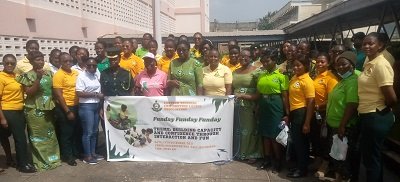
Madam Freda Agyemang who doubles as a Physician Assistant was speaking at the annual anniversary celebration of the Eastern Regional branch of the Ghana Immigration Service Ladies Association on the theme “Building Capacity and Confidence Through Interaction and Fun” here in Koforidua.
She advised ladies to always dress to cover their breasts to avoid having direct contact with the sun and the consequence of contracting cancers which may result in loosing either one or both breasts in future.
She urged them to cultivate the habit of personal breast examination the next day after their menstrual cycle and also ensure that they attend health facilities two times in a year for possible early detection and treatment.
“As women, we need to pay particular attention to our breasts because any untreated health condition leads to death and if we don’t want to die early, it is important that we frequently examine our breasts to ensure that they are always healthy”, she added.
Madam Freda Agyemang said that wearing tight brassiere restricts blood flow in the breast and advised that it was important to always allow the breast to relax when at home in order to permit free circulation of blood through it.
On her part, the Eastern Regional Commander of the Ghana Immigration Service, Deputy Commissioner of Immigration (DCI), Prudence Abu Sosu Azalekor said that though the Immigration Ladies Association had been in existence for decades was inaugurated in 2009 aimed at bringing ladies in the service under one umbrella and empower them to attain their potentials while they contribute their quota towards national development.
Other activities that commemorated the day included health screening, eating competition, dancing competition, lime and spoon race, ludo and oware competitions.
FROM: DAVID KODJO, KOFORIDUA.

The Parliamentary Select Committee on Energy has appealed to the Ministry of Finance to release GH¢5.6 million to the Petroleum Commission to enable it to establish and operate a world-class data centre.
According to the Committee, access to the funds will strengthen the Commission’s capacity to manage critical upstream petroleum data and improve its operations.
Speaking during the appeal, Chairman of the Committee, Emmanuel Kwasi Bedzrah, said the move was crucial to efforts to revitalise Ghana’s upstream petroleum industry and increase oil production.
He noted that although investment and hydrocarbon production had declined in recent years, Parliament’s approval of an extension of the petroleum agreement to 2030 had attracted additional funding and contributed to an increase in production from about 80,000 to 120,000 barrels per day.
Meanwhile, concerns have been raised over repeated budget allocations for oil exploration in the Voltaian Basin.
Mr. Bedzrah stressed that funds approved for exploration must produce tangible results, adding that the Committee would require clear evidence of progress before supporting future budget allocations for the programme.
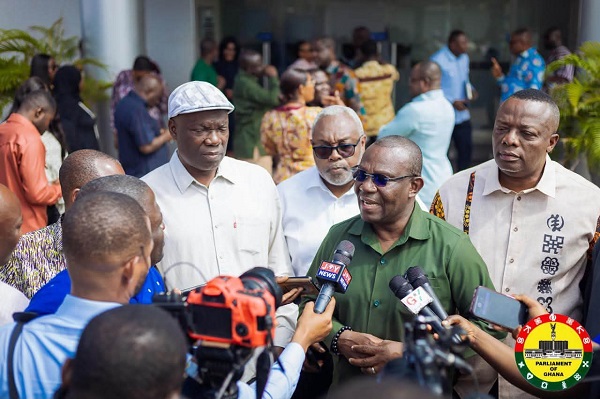
The appeal was made during a working visit to the Petroleum Commission as part of the Committee’s oversight activities to assess its operations and management procedures.
During the engagement, the Chief Executive Officer of the Petroleum Commission, Emeafa Hardcastle, took the Committee through the Commission’s working procedures and mandate, which includes regulating, managing and coordinating upstream petroleum activities.
She disclosed that since assuming office in 2025, government had pursued measures to reverse the decline in crude oil production, sustain output and reposition Ghana as an attractive destination for investment in Africa’s increasingly competitive petroleum sector.
In addition, she said government had secured fresh commitments of about US$35 billion to help revitalise the sector.
As part of the oversight exercise, the Committee is expected to conclude its monitoring visit with engagements at the National Petroleum Authority (NPA) and the Ghana Oil Company Limited (GOIL).
By Edem Mensah-Tsotorme
News
“No civilisation deserves to be annihilated” – Mahama calls for dialogue on global conflicts at UNGA 81

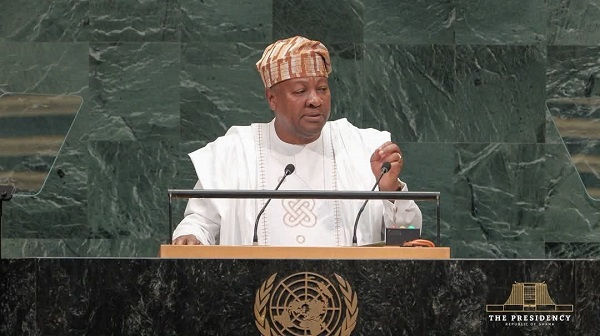
President John Dramani Mahama has called for solidarity and dialogue in resolving global conflicts, insisting that no civilisation deserves to be wiped out.
“No human civilisation deserves to be annihilated, certainly not a member state of the United Nations,” President Mahama stated in his address at the 81st United Nations General Assembly in New York.
He called for solidarity with nations facing terrorism, especially the Alliance of Sahel States (AES), and for a uniform approach to conflicts in Europe, the Middle East and Africa.
On the Middle East, the President called for a return to negotiations, saying “The current Middle East crisis is having a deleterious effect on the world economy.”
“I believe that dialogue can resolve even the most intractable of problems,” he added.
By Edem Mensah-Tsotorme