News
COVID-19: Some traders at Accra Arts Centre close shops over low sales

- /home/u249204778/domains/spectator.com.gh/public_html/wp-content/plugins/mvp-social-buttons/mvp-social-buttons.php on line 27
https://spectator.com.gh/wp-content/uploads/2020/05/Beads.jpg&description=COVID-19: Some traders at Accra Arts Centre close shops over low sales', 'pinterestShare', 'width=750,height=350'); return false;" title="Pin This Post">
- Share
- Tweet /home/u249204778/domains/spectator.com.gh/public_html/wp-content/plugins/mvp-social-buttons/mvp-social-buttons.php on line 72
https://spectator.com.gh/wp-content/uploads/2020/05/Beads.jpg&description=COVID-19: Some traders at Accra Arts Centre close shops over low sales', 'pinterestShare', 'width=750,height=350'); return false;" title="Pin This Post">
Once a vibrant tourist haven of Ghana filled with Ghanaians from the diaspora and other foreign nationals, has virtually become dormant, following the outbreak of coronavirus across the globe.
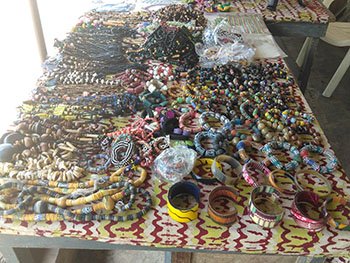
The Accra Arts Centre which is one of the biggest craft markets in the country, had been in existence for about three decades. Tourists could purchase items ranging from woven kente clothes, paintings, wooden sculptures, earrings, textiles and other fashion accessories.
Some traders revealed that prior to the outbreak of COVID-19, they used to make between GH₵500 and GH₵1,000 of sales in a day, depending on your products.
The centre housing over 300 shops, can now boast of a paltry 40 opened shops, after some owners decided to close theirs over low sales and patronage, Vice President of Kente and Adinkra Manufactures Association, Kwame Amakye told The Spectator.
Narrating their challenges to the paper, Kwame Amakye who also plied his trade at the centre for the past 28 years, said following the outbreak of COVID-19 and the closure of borders worldwide, their sector has become one of the hardest hit, making it difficult for traders.
He said majority of their clients were mostly Ghanaians from the diaspora and other foreign tourists, which had been whittled down by the pandemic.
According to him due to the development, most sales have dwindled sharply, making it unprofitable because people incurred transportation cost to the centre, and ended up not making any sales to make ends meet.
“As a result, many shop owners, have decided to stay home, until the situation is improved,” he said.
He added that some of them made it an effort to come, just to ensure that the market did not collapse, in view of the challenges.
Mr Kwame Amakye appealed to government to as a matter of urgency to stimulate the sector, because COVID-19 had dealt a big blow to them. He said every process for the stimulus package must be fast-tracked to save lives and families.
“Sometimes, you receive a call from a colleague requesting for GH₵50, for his family to feed on for that very day, and I ask myself, what happens to the following days?” he quizzed.
A trader, Kwabena Kakra also told the paper that the government’s stimulus package is their only hope for activities to bounce back in the midst of the difficulties
“It is our prayer that a vaccine is found within this shortest possible time to bring situation under control,” he said.
Following the outbreak of COVID-19, movement of people across borders had come to a standstill as countries closed their entry points to contain the virus.
By Edem Mensah-Tsotorme

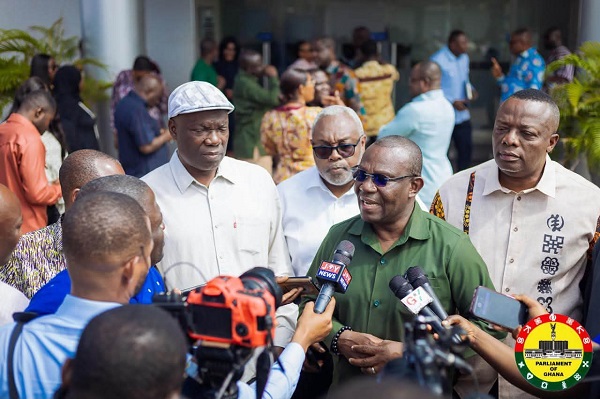
The Parliamentary Select Committee on Energy has appealed to the Ministry of Finance to release GH¢5.6 million to the Petroleum Commission to enable it to establish and operate a world-class data centre.
According to the Committee, access to the funds will strengthen the Commission’s capacity to manage critical upstream petroleum data and improve its operations.
Speaking during the appeal, Chairman of the Committee, Emmanuel Kwasi Bedzrah, said the move was crucial to efforts to revitalise Ghana’s upstream petroleum industry and increase oil production.
He noted that although investment and hydrocarbon production had declined in recent years, Parliament’s approval of an extension of the petroleum agreement to 2030 had attracted additional funding and contributed to an increase in production from about 80,000 to 120,000 barrels per day.
Meanwhile, concerns have been raised over repeated budget allocations for oil exploration in the Voltaian Basin.
Mr. Bedzrah stressed that funds approved for exploration must produce tangible results, adding that the Committee would require clear evidence of progress before supporting future budget allocations for the programme.
The appeal was made during a working visit to the Petroleum Commission as part of the Committee’s oversight activities to assess its operations and management procedures.
During the engagement, the Chief Executive Officer of the Petroleum Commission, Emeafa Hardcastle, took the Committee through the Commission’s working procedures and mandate, which includes regulating, managing and coordinating upstream petroleum activities.
She disclosed that since assuming office in 2025, government had pursued measures to reverse the decline in crude oil production, sustain output and reposition Ghana as an attractive destination for investment in Africa’s increasingly competitive petroleum sector.
In addition, she said government had secured fresh commitments of about US$35 billion to help revitalise the sector.
As part of the oversight exercise, the Committee is expected to conclude its monitoring visit with engagements at the National Petroleum Authority (NPA) and the Ghana Oil Company Limited (GOIL).
By Edem Mensah-Tsotorme
News
“No civilisation deserves to be annihilated” – Mahama calls for dialogue on global conflicts at UNGA 81

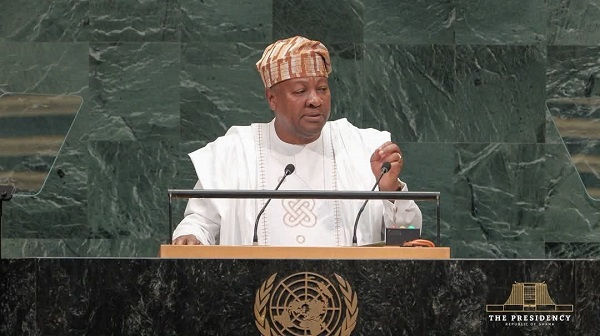
President John Dramani Mahama has called for solidarity and dialogue in resolving global conflicts, insisting that no civilisation deserves to be wiped out.
“No human civilisation deserves to be annihilated, certainly not a member state of the United Nations,” President Mahama stated in his address at the 81st United Nations General Assembly in New York.
He called for solidarity with nations facing terrorism, especially the Alliance of Sahel States (AES), and for a uniform approach to conflicts in Europe, the Middle East and Africa.
On the Middle East, the President called for a return to negotiations, saying “The current Middle East crisis is having a deleterious effect on the world economy.”
“I believe that dialogue can resolve even the most intractable of problems,” he added.
By Edem Mensah-Tsotorme