Hot!
Breaking the bias: Women can also propose to men …Queen declares

- /home/u249204778/domains/spectator.com.gh/public_html/wp-content/plugins/mvp-social-buttons/mvp-social-buttons.php on line 27
https://spectator.com.gh/wp-content/uploads/2022/03/A-section-of-women-at-the-gathering.jpg&description= Breaking the bias: Women can also propose to men …Queen declares', 'pinterestShare', 'width=750,height=350'); return false;" title="Pin This Post">
- Share
- Tweet /home/u249204778/domains/spectator.com.gh/public_html/wp-content/plugins/mvp-social-buttons/mvp-social-buttons.php on line 72
https://spectator.com.gh/wp-content/uploads/2022/03/A-section-of-women-at-the-gathering.jpg&description= Breaking the bias: Women can also propose to men …Queen declares', 'pinterestShare', 'width=750,height=350'); return false;" title="Pin This Post">
The queen of Apinto Divisional Council in the Western Region, Nana Abena Boaduwaa 11, says there is nothing wrong for a woman to make a marriage proposal to a man she loves.
Traditionally in Africa, men usually propose to women who they desire to marry and so, over the years, in accordance with customs and religion, it is men who buy the rings and also present drinks to seal a marriage.
But, in a radical shift, Nana Boaduwaa proposed that, a lady could propose to a man without fear of undermining his status.
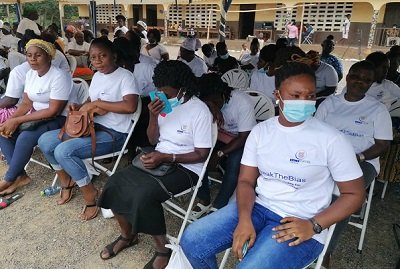
She was speaking with The Spectator on the sidelines of a ceremony to mark this year’s International Women’s Day organised by Gold Fields Ghana Limited, Tarkwa Mine, at Abekoase Tebe, in the Prestea -Huni Valley Municipality of the Western Region on Tuesday.
The day, which celebrates women for their immense contribution towards national development and raises awareness on the need for parity in all spheres of life was on the theme, ‘Break the Bias’.
Nana Boaduwaa stressed “If you’re madly in love with your boyfriend and he hasn’t any intentions of proposing to you anytime soon, you can break the bias and propose to him strategically, that is privately”.
She continued: “Since the guy will know how much the lady loves him, he will be more likely to say ‘yes’ to the proposal.
Vice President of Sustainable Development and Gold Fields West Africa, Dr Celestina Allotey, also said the prioritisation of girl-child education should be the focus of parents.
She added “I am emphasising the education of girls because of the perception of people that even when the girls go to school they will end up in the kitchen. I am a woman but because I was sent to school and I took my education seriously, I am currently an engineer in the mining company and I cook in the kitchen too.”
Dr Allotey disagreed to the idea that education of boys should take precedence over that of girls, adding “we normally use social and cultural misconceptions to discriminate against girls in terms of access to education.”
“Even though today, more parents are educating their girls, there still exist some levels of prejudice against the education of girls,” she indicated.
The Prestea -Huni Valley Municipal Director of Education, Mrs Mary Vida Kwofie, also admonished girls to concentrate on their studies to become future assets to their parents and the nation.
From Clement Adzei Boye, Abekoase Tebe



The Tema Regional Police Command has arrested a 32-year-old man for allegedly posing as a soldier and extorting money from unsuspecting members of the public at Ashaiman.
The suspect, identified as Bright Atsu Kudiabor, was arrested by the Ashaiman Police on Wednesday, September 16, 2026, at about 7:00 a.m.
According to the Police, he was arrested at an area known as “I Shall Return”, where he was allegedly parading himself as a soldier and demanding money from people.
The Police said Kudiabor, who is an ex-convict, was initially arrested by personnel of the Ghana National Fire Service in Ashaiman with assistance from other members of the public.
A search conducted on him after he was handed over to the Police reportedly led to the recovery of a set of military camouflage uniform.
The suspect is currently in Police custody and assisting with investigations.
The Tema Regional Police Command said he would be processed for court after investigations are completed.
The Police urged the public to remain vigilant and report anyone who falsely presents themselves as a soldier or a member of another security agency to deceive or extort money from the public.
By: Jacob Aggrey
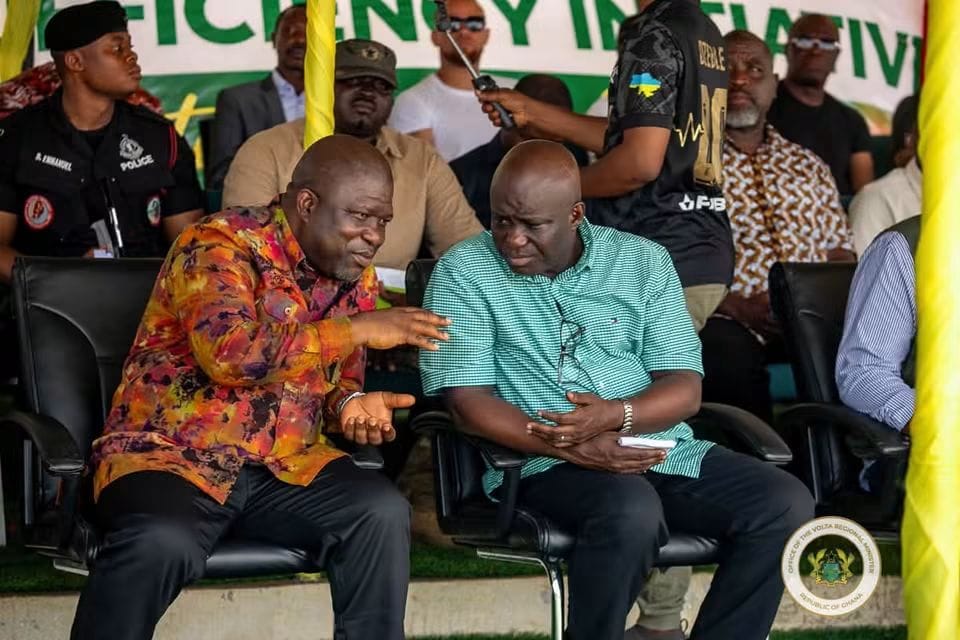
Volta Regional Minister, James Gunu, says the Volta Region holds enormous agricultural potential and efforts must be geared towards connecting farmers to the needed resources to unlock that potential.
He said focus must be on linking farmers to resources, technology, financing and markets to increase production, create jobs and build sustainable livelihoods.
Hon. Gunu made the remarks at the national launch of the Ghana Tomato Self-Sufficiency Initiative (GHATSI) held at Anloga in the Volta Region on Tuesday, September 15.
The initiative, under the theme “Produce at Home. Feed the Nation. Export the Surplus,” seeks to boost local tomato production, processing and marketing while reducing Ghana’s heavy reliance on imported tomatoes.
The launch was attended by the Minister for Food and Agriculture, Eric Opoku, his Deputy, John Setor Dumelo, Feed Ghana Coordinator, Bright Demordzi, Members of Parliament, traditional leaders, MMDCEs, farmers and other stakeholders.
Mr.Gunu expressed appreciation to the Minister for Food and Agriculture for the support announced for the region, including two excavators, 200 cartons of organic fertiliser, and GH¢200,000 for Ms. Kuatudzo Esther Dela, a tomato farmer and processor from Ziope.
He described the initiative as an important step towards making agriculture a stronger driver of food security, job creation and economic growth in the Volta Region.
By Edem Mensah-Tsotorme