News
Being a Channel of Truth and Holiness (Part II)

- /home/u249204778/domains/spectator.com.gh/public_html/wp-content/plugins/mvp-social-buttons/mvp-social-buttons.php on line 27
https://spectator.com.gh/wp-content/uploads/2025/10/The-doctrine-of-holiness.jpg&description=Being a Channel of Truth and Holiness (Part II)', 'pinterestShare', 'width=750,height=350'); return false;" title="Pin This Post">
- Share
- Tweet /home/u249204778/domains/spectator.com.gh/public_html/wp-content/plugins/mvp-social-buttons/mvp-social-buttons.php on line 72
https://spectator.com.gh/wp-content/uploads/2025/10/The-doctrine-of-holiness.jpg&description=Being a Channel of Truth and Holiness (Part II)', 'pinterestShare', 'width=750,height=350'); return false;" title="Pin This Post">
“Again Jesus called the crowd to Him and said, ‘Listen to me, everyone, and understand this. Nothing outside a man can make him “unclean” by going into him. Rather, it is what comes out of a man that makes him “unclean.”’” – Mark 7:14-16 (NIV)
Introduction
The word “channel” signifies action — to direct, lead, or train — and as a noun, it refers to a conduit or means of access. More profoundly, it also describes roles such as advertiser, delegate, witness, communicator, and spokesperson.
As Christians, Acts 1:8 reminds us that we are the channels through whom others come to know Christ — His representatives and messengers on earth. We are called to communicate the message of salvation through Jesus Christ, even though the world often amplifies political voices above the life-giving truth that only Jesus saves.
Holiness
In our last section on holiness, we said that in 1 Peter 1:3-16, Peter writes to believers on what the Bible says about holiness: “Therefore, prepare your minds for action; be self-controlled; set your hope fully on the grace to be given you when Jesus Christ is revealed. As obedient children, do not conform to the evil desires you had when you lived in ignorance. But just as He who called you is holy, so be holy in all you do; for it is written: ‘Be holy, because I am holy.’”
Peter is quoting from Leviticus 11:44 and Leviticus 19:2.
First, let us look at God’s holiness. What does it mean that God is holy? Passages like 1 Samuel 2:2 and Isaiah 6:3 are just two of many examples of passages about God’s holiness. Another way to say it is that holiness is absolute perfection. God is unlike any other, and His holiness is the essence of that “otherness.” His very being is completely absent of even a trace of sin (James 1:13; Hebrews 6:18). He is high above any other, and no one can compare to Him (Psalm 40:5).
God’s holiness pervades His entire being and shapes all His attributes. His love is a holy love, His mercy is holy mercy, and even His anger and wrath are holy anger and holy wrath. These concepts are difficult for humans to grasp, just as God is difficult for us to understand in His entirety.
We now continue with part two of the article. Please enjoy and pass it on!
The Bible and Holiness
Next, what does it mean for us to be holy? When God told Israel to be holy in Leviticus 11:44 and 19:2, He was instructing them to be distinct from the other nations by giving them specific regulations to govern their lives. Israel is God’s chosen nation, and God has set them apart from all other people groups. They are His special people, and consequently, they were given standards that God wanted them to live by so the world would know they belonged to Him.
When Peter repeats the Lord’s words in 1 Peter 1:16, he is talking specifically to believers. As believers, we need to be “set apart” from the world unto the Lord. We need to be living by God’s standards, not the world’s. God is not calling us to be perfect, but to be distinct from the world.
1 Peter 2:9 describes believers as “a holy nation.” It is a fact! We are separated from the world; we need to live out that reality in our day-to-day lives, which Peter tells us how to do in 1 Peter 1:13-16.
Rev. Dr Joyce Aryee, the author


Over 20 structures built within the 50-metre buffer zone of the Kpeshie Lagoon at the Laboma Beach Resort in the La Dade-Kotopon Municipality were on Sunday demolished by the Greater Accra Regional Coordinating Council (GARCC).
Buildings such as single-unit semi-detached under construction and completed chalets at the resort were pulled down while portions of a newly constructed perimeter wall were also demolished. Read More
SKIP THE QUEUE, TAP THE NEWS
You can now read the Ghanaian Times and The Spectator newspapers from the comfort of your device via TimesNewsPlus.
Join our WhatsApp Channel: https://whatsapp.com/channel/0029VbBElzjInlqHhl1aTU27

About 120 golfers from clubs across Ghana participated in an 18-hole competition, dubbed ‘MTN 30th Anniversary CEO Invitational Golf Tournament’ held at the Achimota Golf Club on Saturday.
At the end of the hectic day, Frederick Semenu Duvor won the Men’s Group A event with 39 points, while Julienne Afi claimed the Ladies’ Group A title with the same score.
Yaw Mireku Jnr. won the Men’s Group B with an impressive 45 points, while Kous Louanges Mang took the Ladies’ Group B title with 38 points.
Kofi Mangesi won Men’s Group C with 40 points while Elorm R. Akuash Bonney claimed the Ladies’ version with 42 points.
In the Seniors Division, Jan Vogel emerged winner of the men’s category with 39 gross, while Helen Appah topped the ladies’ category with 44 gross.
Addressing participants, the company’s Board Chairman, Mr Ishmael Yamson, urged the company to approach its next phase with the same resilience, discipline and determination that have defined its success over the past three decades.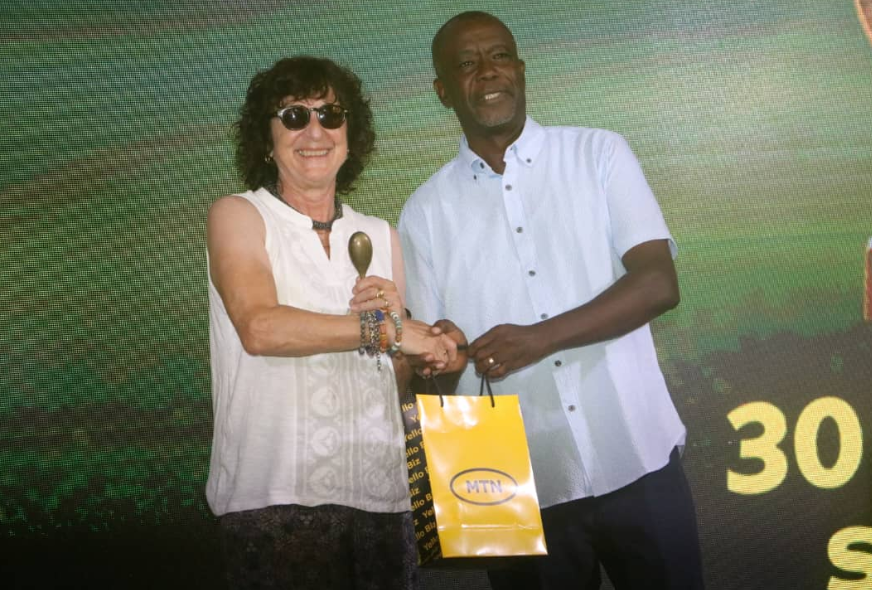
He drew a striking parallel between the game of golf and MTN Ghana’s three-decade journey, describing both as long games in which success depends less on one spectacular moment than on consistency, patience, judgment and the ability to recover from setbacks.
He said, golf had taught him a lesson that extended far beyond the fairways, thus, a round cannot be won on the first hole.

In golfing terms, he said, MTN Ghana had encountered its share of regulatory bunkers, competitive hazards and unexpected storms that had forced the company to pause, reassess and change its approach.
But those challenges, he suggested, were part of the journey rather than reasons to abandon it.
By Andrew Nortey
SKIP THE QUEUE, TAP THE NEWS
You can now read the Ghanaian Times and The Spectator newspapers from the comfort of your device via TimesNewsPlus.
Join our WhatsApp Channel: https://whatsapp.com/channel/0029VbBElzjInlqHhl1aTU27

 Entertainment1 week ago
Fiifi Coleman Productions adapt ‘I Told You So’ stage play into feature film
- News1 week ago
48 Engineer Regiment to be major sub-contractor on Accra-Kumasi Expressway, $2bn ready- Prez Mahama
- Entertainment6 days ago
Rhythms On Da Runway returns November 28 with 16th edition themed ‘Unbound’