News
Unemployed sentenced 15 years for robbery

- /home/u249204778/domains/spectator.com.gh/public_html/wp-content/plugins/mvp-social-buttons/mvp-social-buttons.php on line 27
Warning: Trying to access array offset on false in /home/u249204778/domains/spectator.com.gh/public_html/wp-content/plugins/mvp-social-buttons/mvp-social-buttons.php on line 27
&description=Unemployed sentenced 15 years for robbery', 'pinterestShare', 'width=750,height=350'); return false;" title="Pin This Post">
- Share
- Tweet /home/u249204778/domains/spectator.com.gh/public_html/wp-content/plugins/mvp-social-buttons/mvp-social-buttons.php on line 72
Warning: Trying to access array offset on false in /home/u249204778/domains/spectator.com.gh/public_html/wp-content/plugins/mvp-social-buttons/mvp-social-buttons.php on line 72
&description=Unemployed sentenced 15 years for robbery', 'pinterestShare', 'width=750,height=350'); return false;" title="Pin This Post">
After one-and-half years trial, the Accra Circuit Court “11” has sentenced a 21-year-old unemployed young man to 15 years imprisonment for robbing an Engineer at knife point.
The convict, Benjamin Borteye Odiafa, together with two other persons (currently on the run) attacked Mr Samuel Igbinosun, an automobile engineer in his room at Marte-Bu, Nungua, on October 10, 2018, with a knife and robbed him of his 55 inches Akai flat screen television set and iPhone 7 plus.
Inspector Samuel Ahiabor, prosecutor, told the court presided by Mrs Priscilla Dapaah Mireku that the victim sustained serious injuries on his head and right hand.
He said that the criminals, after the act, went and gave the stolen items to another person called Poppy for safe keeping but the convict (Odiafa) later went for the flat screen television set and sold it out to one Samuel K. Blankson (2nd Accused) at GH¢100.00.
The court, however, found Blankson not guilty of the offence of dishonestly receiving and accordingly acquitted and discharged him.
Inspector Ahiabor said that a report was made to the police at Nungua where Odiafa was arrested and he led the police to arrest Blankson who bought the TV but the set was retrieved.
He said that the convict admitted the offence in his cautioned statement and explained that they rather attacked the victim with a screw driver, not a knife as claimed.
Source: Ghanaian Times



A nine-member board for the New Times Corporation (NTC), publishers of The Ghanaian Times and The Spectator newspapers was sworn into office on Thursday with a call to strengthen the governance of the Corporation.![Dr. Binka (seated second from right) with Dr Okpoti [right] the board and Management of NTC photos Okai Elizabeth.](https://spectator.com.gh/wp-content/uploads/2026/08/Dr.-Binka-seated-second-from-right-with-Dr-Okpoti-right-the-board-and-Management-of-NTC-photos-Okai-Elizabeth-1024x683.jpg)
The new NTC board is chaired by Dr Charity Binka and has Very Rev. Helena Amma Serwah Opoku-Sarkodie, Mr Tito Kojo Voegborlo Esq and Naana Aklerh Amenyah Kubi I as members. Read More
SKIP THE QUEUE, TAP THE NEWS
You can now read the Ghanaian Times and The Spectator newspapers from the comfort of your device via TimesNewsPlus.
Join our WhatsApp Channel: https://whatsapp.com/channel/0029VbBElzjInlqHhl1aTU27

Christians have been urged to demonstrate a living faith in Jesus Christ by allowing their confession of Him as Lord and Saviour to reflect in their daily lives.
According to the Kaneshie District Pastor of the Evangelical Presbyterian Church, Ghana (EPCG), Rev. Dzidzor Nathaniel Affram, a genuine Christian’s confession should go beyond words and be demonstrated through obedience to God, love for others and service to the Church.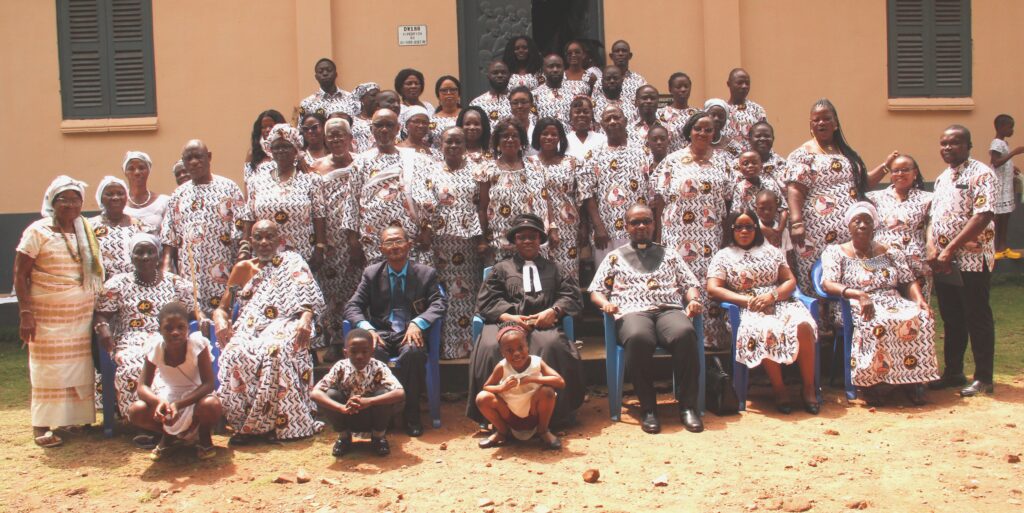
He made the call at the 40th anniversary remembrance service for the late Wesley Kwasi Kwadzo at the Evangelical Presbyterian Church, Ghana, Maranatha Congregation at Awudome Avenui in the Volta Region.
Speaking on the theme, “The Church Built on a Living Confession,” Rev. Affram said life would continually present challenges capable of testing Christians’ faith, making it necessary for believers to hold firmly to their confession that Jesus Christ is Lord.
He explained that accepting Jesus Christ as Lord and Saviour required Christians to live according to His teachings, stressing that their faith must be evident in their conduct.
“A living confession listens to God and not man,” he said, urging Christians to remain obedient to God even when faced with difficulties and pressures.
Rev. Affram further encouraged the congregation to care for vulnerable people and demonstrate concern for others, adding that such acts were practical expressions of Christian faith.
He also urged Christians to identify and use their God-given gifts to build the Church.
He said every member of the Church had a role to play and cautioned Christians against looking down on others because of their status or abilities.
The remembrance service brought together family members, friends, members of the congregation and sympathisers to commemorate the 40th anniversary of the late Wesley Kwasi Kwadzo.
By Lizzy Okai