News
“Properly use prescribed eye drops to avoid having complications from wrongful usage”

- /home/u249204778/domains/spectator.com.gh/public_html/wp-content/plugins/mvp-social-buttons/mvp-social-buttons.php on line 27
https://spectator.com.gh/wp-content/uploads/2023/03/WhatsApp-Image-2023-03-21-at-4.11.40-PM.jpeg&description=“Properly use prescribed eye drops to avoid having complications from wrongful usage”', 'pinterestShare', 'width=750,height=350'); return false;" title="Pin This Post">
- Share
- Tweet /home/u249204778/domains/spectator.com.gh/public_html/wp-content/plugins/mvp-social-buttons/mvp-social-buttons.php on line 72
https://spectator.com.gh/wp-content/uploads/2023/03/WhatsApp-Image-2023-03-21-at-4.11.40-PM.jpeg&description=“Properly use prescribed eye drops to avoid having complications from wrongful usage”', 'pinterestShare', 'width=750,height=350'); return false;" title="Pin This Post">
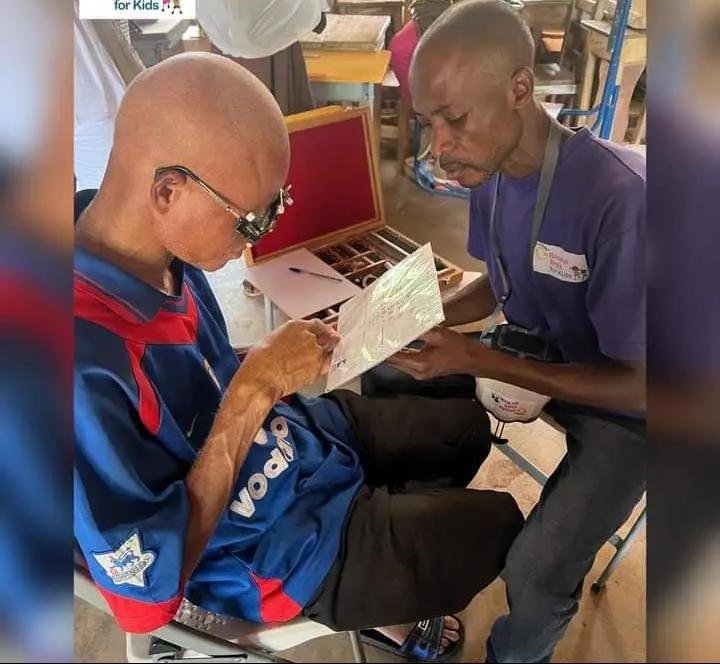
An Optometrist and Manager of Bliss Eye Care, Dr Zakarea Al-hassan Balure, a private eye care clinic in Wa in the Upper West Region has advised persons suffering from eye conditions to properly use prescribed eye drops to avoid having complications from wrongful usage.
He stated that some of the medications sold on the market were not registered and said even if they were, users still required education on how to use the eye drops properly in order not to complicate their eye problems and also prevent future challenges.
Dr Balure said this at a free eye screening exercise organised for residents of Bawiesibai in the Sissala East Municipality as part of activities scheduled for the grand coronation of Alhaji Abdul Salam Bachewii Akate as the Paramount Chief of the Bawiesibai Traditional Area.
Out of 605 people screened, 535 of them had pathological problems comprising 13 refractive errors, and 12 cases of Cataract and Glaucoma, among others and were given eye drops for the minor problems.
Dr Balure said eye complications, particularly cataracts had led to many blind cases which could have been avoided if they received prompt screening, the right information, and the needed support.
He also noted that eye problems, when detected early, could be controlled or treated to prevent blindness in future and called on the public to pay critical attention to their eyes by seeking early treatment.
Speaking on behalf of the chiefs and people of Bawiesibai, Madam Shaida Akate expressed gratitude to Bliss Eye Care and the team for their excellent job done for the people of Bawiesibai.
She said there was still a lot of work to be done in the community as many people did not know the importance of the screening and pledged their support to organize such programmes frequently.
The beneficiaries expressed gratitude to Bliss Eye Care for the intervention and said bringing the free screening and educating them on the use of the eye drop was a blessing even though most of them did not have a clue on how to use the eye drop.
FROM RAFIA ABDUL RAZAK, WA


A nine-member board for the New Times Corporation (NTC), publishers of The Ghanaian Times and The Spectator newspapers was sworn into office on Thursday with a call to strengthen the governance of the Corporation.![Dr. Binka (seated second from right) with Dr Okpoti [right] the board and Management of NTC photos Okai Elizabeth.](https://spectator.com.gh/wp-content/uploads/2026/08/Dr.-Binka-seated-second-from-right-with-Dr-Okpoti-right-the-board-and-Management-of-NTC-photos-Okai-Elizabeth-1024x683.jpg)
The new NTC board is chaired by Dr Charity Binka and has Very Rev. Helena Amma Serwah Opoku-Sarkodie, Mr Tito Kojo Voegborlo Esq and Naana Aklerh Amenyah Kubi I as members. Read More
SKIP THE QUEUE, TAP THE NEWS
You can now read the Ghanaian Times and The Spectator newspapers from the comfort of your device via TimesNewsPlus.
Join our WhatsApp Channel: https://whatsapp.com/channel/0029VbBElzjInlqHhl1aTU27

Christians have been urged to demonstrate a living faith in Jesus Christ by allowing their confession of Him as Lord and Saviour to reflect in their daily lives.
According to the Kaneshie District Pastor of the Evangelical Presbyterian Church, Ghana (EPCG), Rev. Dzidzor Nathaniel Affram, a genuine Christian’s confession should go beyond words and be demonstrated through obedience to God, love for others and service to the Church.
He made the call at the 40th anniversary remembrance service for the late Wesley Kwasi Kwadzo at the Evangelical Presbyterian Church, Ghana, Maranatha Congregation at Awudome Avenui in the Volta Region.
Speaking on the theme, “The Church Built on a Living Confession,” Rev. Affram said life would continually present challenges capable of testing Christians’ faith, making it necessary for believers to hold firmly to their confession that Jesus Christ is Lord.
He explained that accepting Jesus Christ as Lord and Saviour required Christians to live according to His teachings, stressing that their faith must be evident in their conduct.
“A living confession listens to God and not man,” he said, urging Christians to remain obedient to God even when faced with difficulties and pressures.
Rev. Affram further encouraged the congregation to care for vulnerable people and demonstrate concern for others, adding that such acts were practical expressions of Christian faith.
He also urged Christians to identify and use their God-given gifts to build the Church.
He said every member of the Church had a role to play and cautioned Christians against looking down on others because of their status or abilities.
The remembrance service brought together family members, friends, members of the congregation and sympathisers to commemorate the 40th anniversary of the late Wesley Kwasi Kwadzo.
By Lizzy Okai