Features
Leakages and academic dysentery

Student life just prior to GCE exams is as interesting and adventurous as it is tragic. It is a period during which recalcitrant finalists are tempted to break into backyard poultry outfits of senior house-masters, so that they can enjoy chicken-soup while “ghosting.”
And in mixed schools, it is during this revision period that boys and girls alternate studies with romance in such a way that at the beginning of the long vacation, the girls can clandestinely approach unscrupulous doctors to scoop out growing babies from their bellies.
A few weeks to the beginning of the first paper, many students develop physical and imaginary illnesses ranging from amnesia to kpokpomatics (nervousness). The budding finalist who is serious and level-headed plans his study time-table and allots time for bath, meals, siesta and snoring.
Such candidates follow their own regimented programme to the letter and enjoy normal life while studying for their exams. They are health-conscious, do not take drugs and they enjoy rest to avoid brain fag.
There are other serious students, however, who are not concerned about health. They are so busy, or claim to be, that they refuse to take their bath, comb their hair, wash their hands before eating and sometimes, simply refuse to go to “toilet”. This is quite revolutionary and I wonder how they manage it. But that is not all.
They take ‘caterpillar’ to keep awake, fail to wash their cover-cloths, and have air conditioners permanently installed in their armpits. These are students who are on the war-path towards academic distinction but ironically very few of them do well.
Some are so over-zealous that they pack and carry books for all their eight or so subjects to the classroom swearing to ‘chew’ all before day-break. They end up learning virtually nothing because they prefer the rhythmic snoring using their books as pillow to cramming Abbot.
The following morning, they will be the first to impress their colleagues: “I swear my father’s moustache that last night I did what Napoleon could not do.” For sure, Napoleon did not sleep that much. Ninety per cent of such students end up in the academic grave with grade 9s, subsidiary passes and FAIL as their lot.
Incidentally, however, those category of students are more acceptable to organised society than the happy-go-lucky ones who regard academic excellence as sacrilegious and, therefore, include discoing, wee-smoking, chasing form-two girls and stealing gari from frail chop boxes in their study programme.
These are the students who are so intellectually deviant that they keep on praying papers should leak so that they can prove to their ‘book-long’ fellows they are a force to reckon with.
A month to exams they go hovering about West African Examinations Council (WAEC), forcing tete-a-tete with crooked officials some of whose faces look hungry enough to accept money in exchange for exam papers.
Others trot from school to school contacting friends of similar feather to obtain information about possible leakage points. The girls become unusually liberal to the Assistant Headmaster who may, as a reciprocal gesture, be tempted to ‘peep’ two or three Maths questions from one paper to offer as sure tips after carefully changing the wording. These assistant heads, therefore, become alphabetical surgeons; a very infamous occupation.
In the 70s, the incidence of leakages and exam malpractices became so rampant among the WAEC countries that Nigeria swore to rid its territory of the epidemic.
They did succeed. Sikaman authorities also swore same, and for some time, ears became free from news about leakages, impostors and ‘copiato’ (copying during exams).
But just as we had begun the last decade of the 20th Century, the plague re-surfaced and today some students and their allies are under lock and key for the part they played in this scholastic uprising.
Papers leak right from WAEC strong rooms, police stations and assistant headmasters’ vaults.
When papers for instance go into transit at the police station for onward transmission to the exam centres, surgical operations are performed on the sacks and the papers extracted and put on sale on the open market.
Sometime ago, the situation degenerated so much that Makola women were seen hawking. Additional Mathematics papers just like tomatoes and garden-eggs.
One interesting but unfortunate thing about leakages is that it does no one ultimate good. To a brilliant student, a leaked paper in his possession makes him unable to justify his intellectual capacity and his scholastic worth is over-shadowed.
To the brainless, it is simply a disaster. He has no brains whatsoever to imbibe solution to the answers. He has to choose the alternative of entering the exam room with copied answers. And there, he becomes a copy-writer and proof-reader. Speed is his best asset, but he is most likely to be caught.
One block-headed student who acquired a leaked paper was faced with the problem of choosing between ‘chewing’ the answers (which was virtually impossible in view of his deficient IQ), and turning himself into a speed copy-writer. He however decided to do neither of these.
In the exam room he considered his plight. All his friends and enemies were also in possession of the paper and had prepared so well that they were going to clock beautiful grades. And he, the only JUDAS in the lot will surely wind up with a grade 9. What!! God forbid!
On the answer sheet he wrote a very brilliant letter to the examiner in clear hand-writing and similar to this:
“Dear Sir, this very paper you are marking is under massive leakage, and I know that people are going to blow it paa-a! But as for me, although I also had all the questions, I am as daft as a live sheep. My father had no brains in his big head. As for my mother, the least said about her, the better. And as you know that a dog does not beget a cat, I was born an idiot.”
“So when I got the questions, I didn’t know what to do with them. Will you please therefore consider me and pass me too. Otherwise, I alone will die of academic dysentery. Thanks for your usual cooperation. Yours faithfully…”
The paper was cancelled, and students had to suffer the expense of re-registration and frustration, not forgetting the loss of time.
The only solution to this grave problem of exam leakages and allied criminal offences is that the law must prescribe stiffer punishments for those who perpetrate and or collaborate to further these criminal practices.
Those convicted of these offences must be packed away for as long as would be possible to make them forget about exam papers. Such a deterrent measure would help minimize the problem. Proper security arrangements must be organized by authorities of WAEC to rid Sikaman of this recurrent menace.
We must all endeavour to prevent the situation where outsiders will feel inclined to refuse recognising our dear certificates which many have toiled for, but which a dangerous few want to obtain without sweat.
This article was first published on Saturday, June 30, 1990.

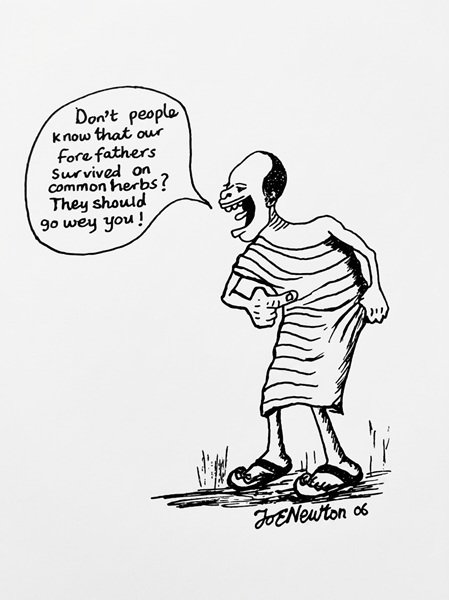
THE typical itinerant salesman in Sikaman is a herbalist. He is normally a slim macho with the capacity to perambulate the expanse of area covering the triangle of Accra-Tema-Ashiaman. In short, he can walk a total of 60 miles a day, marketing a product that cures every disease, including poverty. 
The door-to-door herbal pharmacist advertises his product by word of mouth. He has nothing to do with the Food and Drugs Board (FDB). After all, his concoctions do not feature on FM stations.
Those herbalists who cannot walk to propagate the herbal gospel, liaise with drivers of mass transportation and their mates. They are, therefore, given the chance to sell their products on Benz buses that ply the routes.
Normally, the herbalist starts his sales message with a prayer and Bible study. He asks the passengers to bow down their heads in supplication to God the father, the son, the Holy Spirit.
When a herbalist asks the passengers to close their eyes and bow their heads, Moslems on board naturally feel offended. They feel that the herbalist has no right to assume that every passenger is a Christian. They think such an assumption is an affront to Islam.
So a Moslem on board will raise the hand for a point of order. He’ll remind the herbalist that it would be in his own interest to mind his language.
“Be careful the way you address people in a public place. Not every person here is a Christian,” he’d state assertively.
Of course, the herbalist will promptly ignore him, but would all the same “watch” his tongue. Who knows whether or not the Moslem brother is inspired by Quoranic zeal to defend the tenets of Islam to the hilt?
When he starts saying, “Wallahi!” and “Inshallah!” it could be the beginning of proclaiming Islam as supreme, a point which must be driven home with talibanic precision.
So the herbalist must tread carefully lest he steps on fire.
The herbalist could even add a measure of mirth to it all, by announcing that Christians on board today have very interesting company on the journey, but that should not detract from the business of the day.
The Moslem brother will weigh the words carefully and offer a wry smile.
He must be careful the occasion does not degenerate into the use of semantics and proverbial oration to deride his conviction that public utterances must be mindful of religious sensibilities. He has made his point very clear and expects that it is taken in good faith in the interest of a peaceful journey.
The herbalist will now open the New Testament and preach salvation, stating clearly that salvation can come only through Jesus Christ and NOBODY else.
The Moslem brother will now start twitching his moustache. The visible and almost revolutionary reflexes of his upper lip can be an indication that sentiments have begun superseding reason, and the outcome could well be tragic now shift uneasily in his seat.
The time has come for him to also express his right to the religion of his fore-bears. He’ll put his hand into his pocket and rise to his feet. The time has indeed come!
This article was first published on Saturday, September 9, 2006
When the cause of a particular problem like sickness, disease, sudden illness, a social issue etc. are not known, it stands to reason that resolving it becomes a huge challenge.
Citizens would understand the government when public announcements are made to the effect that government is trying to find a solution to the issue, even though it is taking a while for it to be resolved because citizens are rational beings.
On the other hand, if the solution to a particular issue is known to everybody but the government for whatever reason, is dragging its feet in resolving it, citizens become frustrated and begin to lose trust in their leaders.
One such issue is the heavy traffic along a section of the Kasoa – Odokor road. A short stretch of bad road between the traffic light at the Weija Government Hospital and the entrance to the entrance of the overhead that leads to the N1, is the cause of the problem but nothing is being done about it, day after day, week after week, month after month. Thus is clearly unacceptable.
Another issue that requires urgent attention is the lack of pavements along a lot of streets in parts of the various Municipal Assemblies. Exercise is a prerequisite for long life and healthy living and for those of us who it has become a way of life, this issue of people putting up structures right to the edge of the drains beside the roads, are making life difficult for us.
We are compelled to walk along the roads, putting our lives at serious risk. Pedestrians should never be compelled to compete with vehicles on our streets and roads. Roads and streets are made for vehicles and pavements are made for pedestrians. That is the norm. Any attempt to normalise a situation where pedestrians are mingling with vehicles is insanity.
It is the road regulations that makes it so and therefore district or municipal assemblies are to take responsibility and ensure that spaces for pavements are not encroached upon. Citizens have rights that must be protected by their leaders and making pavements available to pedestrians, is one of them.
When we hear of teachers having sex with students, it appears it is something recent. It is not a new phenomenon. It has been there since Adam. Perhaps this issue is getting much attention due to the proliferation of social media. It was an open secret in times past when Teachers were in relationships with female students and some married them immediately after completion of school.
Some teachers were also known to be having unholy interactions with female pupils but due to the times that these acts occurred, human rights issues and the awareness around it, allowed such unscrupulous teachers to get away with their crimes.
Now we are in a different era and so a Headmaster is now in hot waters. He is alleged to have raped about 19 female students and as usual, some officials tried to cover it up and are also in hot waters and their actions or inactions in the matter are under investigation.
Why the man has been allowed to roam freely without being arrested is simply mind boggling. It appears that the law applies differently, depending on who you are. This issue came to public attention sometime in August this year, yet the police had not arrested or invited this man for question regarding the rape allegation.
It has come out that he is a Constituency Secretary of the ruling party and the question in the public domain is that, is it because he is a political figure that is why he is still walking around without questioning? I believe in the rule of law so let us hold our breadth and let the proper thing be done.
The police must however be seen to be active in this matter. God bless.
SKIP THE QUEUE, TAP THE NEWS
You can now read the Ghanaian Times and The Spectator newspapers from the comfort of your device via TimesNewsPlus.
Join our WhatsApp Channel: https://whatsapp.com/channel/0029VbBElzjInlqHhl1aTU27