Hot!
Intensify Continental Trade To Unlock $450bn Afcfta Income – Pres Akufo-Addo

- /home/u249204778/domains/spectator.com.gh/public_html/wp-content/plugins/mvp-social-buttons/mvp-social-buttons.php on line 27
https://spectator.com.gh/wp-content/uploads/2024/01/fb65b563-ac5b-43b7-95a8-12612743d22f.jpeg&description=Intensify Continental Trade To Unlock $450bn Afcfta Income – Pres Akufo-Addo', 'pinterestShare', 'width=750,height=350'); return false;" title="Pin This Post">
- Share
- Tweet /home/u249204778/domains/spectator.com.gh/public_html/wp-content/plugins/mvp-social-buttons/mvp-social-buttons.php on line 72
https://spectator.com.gh/wp-content/uploads/2024/01/fb65b563-ac5b-43b7-95a8-12612743d22f.jpeg&description=Intensify Continental Trade To Unlock $450bn Afcfta Income – Pres Akufo-Addo', 'pinterestShare', 'width=750,height=350'); return false;" title="Pin This Post">
The President of the Republic, Nana Addo Dankwa Akufo-Addo, has called on fellow Heads of States and the global business community to focus on unleashing the 450bn United States dollars AfCFTA-driven potential income, that stands to be accrued from continental trade by 2035.
President Akufo-Addo also believes that, a one percent increase in Africa’s share of global trade from two percent to three percent could generate some seventy billion United States dollars of additional income per annum for the continent.
A key step to achieving this, according to the President, is for all within the global community to support the call for a new investment approach that prioritizes mutually reinforcing partnerships between the private sectors across advanced economies and the economies of Africa.
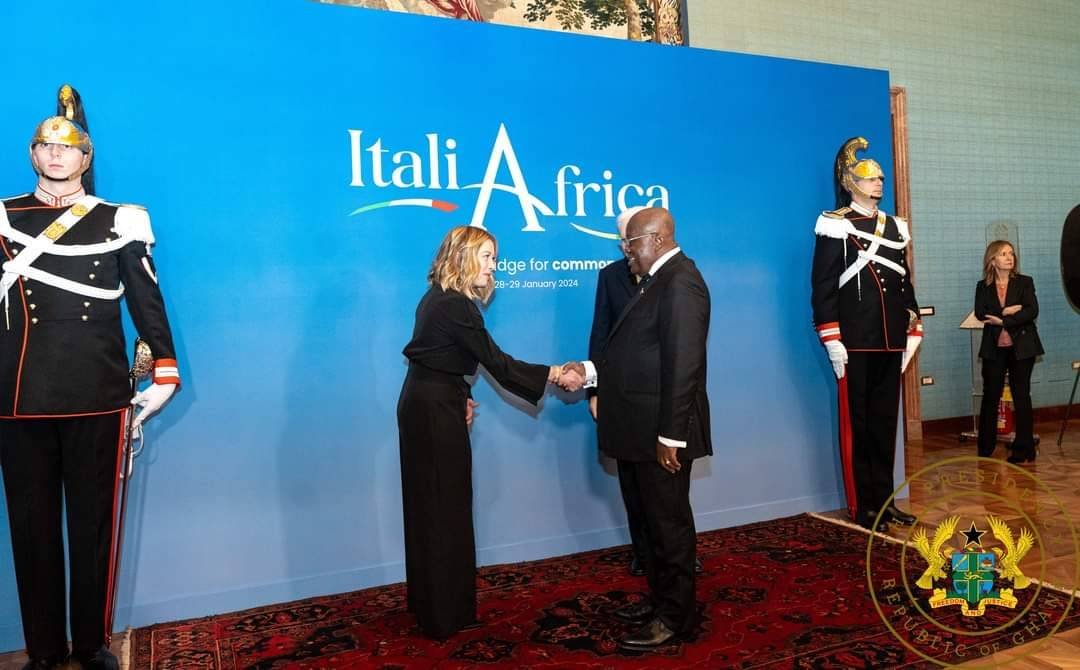
Speaking at this year’s edition of the Africa-Italy summit, on Monday, 29th January 2024, in Rome, Italy, President Akufo-Addo said, in line with the urgency to take the necessary steps towards resiliency as a continent, it is important to avoid “tax-dodging”, which is the illegitimate commercial transactions by multinationals, which account for sixty percent of the US$88 billion of illicit financial flows annually from the continent, and other relationships which inhibit Africa’s development.
With some eighty percent of infrastructural projects in Africa failing at the feasibility and business planning phase, he however noted positively, that with the right reforms and interventions, Africa, according to analysis conducted by the American management consulting firm, Mckinsey & Company, could unlock some US$550 billion of investments annually in infrastructure.
“Before 2020, Africa was attracting increasing foreign direct investment (FDI), although overall FDI inflows remained much lower than in other world regions. Between 2000 and 2019, FDI flows to Africa increased fourfold, with a compound annual growth rate of eight-point-five percent (8.5%). Our biggest challenge is not a scarcity of financing, but a confluence of poor governance, speculative risk perception, and a defective environment for crowding in investors.”
He was confident that with added emphasis placed on creating a de-risked landscape that innovatively crowds in resources from private sources of capital, international financial institutions, and sovereign wealth funds, governments on the continent will have to focus their efforts on delivering transformative investments like infrastructure to boost Africa’s development aspirations.
The African Development Bank says the continent’s infrastructure financing needs will be as much as $170 billion a year by 2025, with an estimated gap of around $100 billion a year.
This is essentially why, with a burgeoning population growing at a rate of 2.5% annually, “it has become even more urgent to provide reliable electricity, affordable and decent housing, improved transportation networks, and accessible health infrastructure.” he emphasised.
Touching on key efforts to engender the delivery of quality economic infrastructure for Africa’s post-COVID-19 recovery, he said, “recent happenings within the global space, particularly the COVID-19 pandemic, the Russian invasion of Ukraine, and the turmoil in the Middle East, which is threatening to engulf the rest of the world, have increased the need for policymakers on the African continent to achieve a structural transformation that yields inclusive and sustainable growth patterns over the medium to long term.”


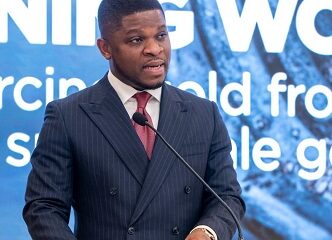
General Secretary of the New Patriotic Party (NPP), Justin Kodua Frimpong, has filed his nomination to contest the position of General Secretary again as the party begins its rebuilding efforts ahead of the 2028 general elections.
He was accompanied by party stalwarts and supporters who were in high spirits, expressing confidence that he is the right person to hold the position.
Speaking after filing his nomination, Mr Kodua Frimpong assured the rank and file of the party that he would not disappoint them.
“I can assure you that the faith the rank and file of the party have had in me, I will never disappoint them,” he said.
He also pledged to run a clean campaign devoid of personal attacks.
“I can assure you that our internal campaign will be devoid of personal attacks,” he told his fellow contestants and the rank and file of the party as he seeks to retain his position.
His tenure has seen the party through the 2024 general elections, where the NPP lost power to the National Democratic Congress (NDC) after eight years in government.
The party is currently in a rebuilding phase, with internal elections scheduled to elect new national executives to lead its reorganization towards the 2028 polls.
The General Secretary position is considered one of the most influential in the party’s administrative structure, responsible for the day-to-day running of the party secretariat and implementation of party decisions.
By Edem Mensah-Tsotorme

The University of Ghana Medical Centre (UGMC) has disputed claims made on social media by comedian Michael Blackson concerning the treatment given to his late mother, saying a review found that the allegations did not accurately reflect what happened during her stay at the hospital.
In a statement issued in Accra on August 5, 2026, the management of UGMC expressed condolences to Mr. Blackson and his family over the death of his 83-year-old mother, who died at the facility on July 16, 2026.
The hospital said it had taken the concerns raised by Mr. Blackson seriously and conducted a thorough review in line with its clinical and administrative procedures.
According to the statement, the facts presented by Mr. Blackson on social media contained “numerous inaccuracies” and did not accurately reflect the medical care provided to his mother.
UGMC explained that she was referred to the facility from another hospital and received treatment there from May 27 to July 16, 2026, a period of about eight weeks.
The hospital stated that it would not release details of her diagnosis, treatment, medical records or other aspects of her care because it had a duty to protect patient confidentiality, even after death.
It said the decision was intended to respect the dignity of the deceased and the privacy of her family.
UGMC further stated that all clinical decisions at the facility are made by qualified healthcare professionals based on medical judgment, established standards of care and the best interests of the patient.
The statement added that such decisions are made in consultation with authorised family representatives where necessary and that billing and financial procedures are governed by institutional policies and are separate from clinical decision-making.
The hospital noted that it values feedback from patients and their families and considers both positive and negative comments important for improving the quality of care.
Mr. Blackson had earlier used social media to criticise the care his mother received at UGMC, prompting the hospital’s response.
By: Jacob Aggrey