Sports
Ghanaians cannot forgive Suarez …10 years after handball incident

- /home/u249204778/domains/spectator.com.gh/public_html/wp-content/plugins/mvp-social-buttons/mvp-social-buttons.php on line 27
https://spectator.com.gh/wp-content/uploads/2020/07/The-infamous-handball-that-denied-the-Black-Stars-and-Africa-a-first-World-Cup-semi-final-berth.jpg&description=Ghanaians cannot forgive Suarez …10 years after handball incident', 'pinterestShare', 'width=750,height=350'); return false;" title="Pin This Post">
- Share
- Tweet /home/u249204778/domains/spectator.com.gh/public_html/wp-content/plugins/mvp-social-buttons/mvp-social-buttons.php on line 72
https://spectator.com.gh/wp-content/uploads/2020/07/The-infamous-handball-that-denied-the-Black-Stars-and-Africa-a-first-World-Cup-semi-final-berth.jpg&description=Ghanaians cannot forgive Suarez …10 years after handball incident', 'pinterestShare', 'width=750,height=350'); return false;" title="Pin This Post">
“For me, the Uruguay game is a game I think we won.” John Paintsil says, looking back on one of the most dramatic matches in men’s World Cup history: the 2010 quarter-final between Ghana and Uruguay in Johannesburg.
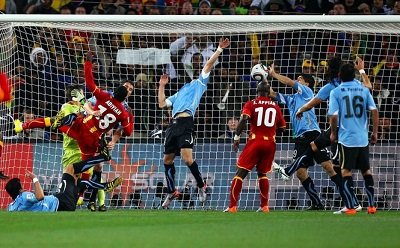
The reality, though, is Ghana did not win. A handball by Luis Suarez stopped a certain goal bound shot deep into injury time, in one of the most controversial and memorial moments of that tournament. Suarez was sent off – but Ghana missed the resulting spot kick and, ultimately, went out on penalties after extra time.
The pain for Paintsil and his teammate Hans Sarpei still lingers, ten years on. For many Ghanaians, Luis Suarez is perpetrator of one of the greatest crimes in the country’s sporting history.
“We were cheated,” Paintsil says.
“To clear the ball from the line with your hand – it’s supposed to be a goal.”
Living in Ghana as he now does, Paintsil says people still keep talking about the incident.
“I can’t forgive him because it was not an accident.” Sarpei adds.
“He knows what he has done. We were crying and you see someone who has cheated us is celebrating. How can I forgive him? Never. Never ever.”
On the July 2, 2010, Ghana had the football hopes of a whole continent on their shoulders.
South Africa was the host of Africa’s first World Cup – but Bafana Bafana was unable to make it past the group stage despite a valiant effort.
The other African teams had all been eliminated at the same point, leaving just the Black Stars in the competition.
“On the way to the game against Uruguay, I think everybody knew we could beat them – I think the whole world was supporting us.” left-back Sarpei says.
“The way we play the game: we’re playing on the front, we’re attacking in front. We try to enjoy the game. When you see Ghana, it’s like you’re listening to music because the ball is flowing.”
Ghana took the lead on the stroke of half-time via a 40-yard thunderbolt from former Portsmouth and Inter Milan midfielder Sulley Muntari.
But Diego Forlan equalised with an exquisite free-kick and the two teams proceeded to play out in an engrossing contest – undoubtedly one of the best games of the competition – with both teams spurning chances throughout the game.
But it’s the final few minutes of the match that will forever live in World Cup infamy.
Ghana won a free-kick on the edge of the box, which was whipped in by Paintsil. In an ensuing goalmouth scramble, Suarez legitimately cleared a shot off the line from Captain Steven Appiah – before, seconds later, palming Dominic Adiyiah header away from goal.
“For me, I thought, ‘last man on the line, touch it with his hand, it’s supposed to be a goal’ – so I was already celebrating that we were through.” Paintsil recalls.
“Then I saw it was a penalty and I said, ‘What?’ I was shouting, ‘No, no, take the ball to the centre (circle), take the ball to the centre.’”
Suarez was sent off, leaving the field in tears, whilst the Ghanaian players began to celebrate.
“I think everybody from our side was thinking ‘yeah, we’re going to the semi-final’ because Asamoah Gyan had scored two penalty goals before and he made it look easy.” Sarpei says.
Gyan had been talismanic for Ghana in the tournament, leading the line and scoring the winner in the previous round against the United States – a game which had also gone to extra time.
“I was standing there and for me the ball was going into the net and we are going through to the next round.” Sarpei recalls.
“Then it hit the crossbar and my first thought was like, ‘is this real?’ Really? The ball is not into the net? What is happening? What is the problem?’
“And then it was difficult. At this moment, when he didn’t score and we had to go to the penalty shootout, the feeling was like, now it will be difficult to go to the next round.”
Suarez, who had stopped in the tunnel to watch the penalty, was pictured celebrating when Gyan missed – something that still rankles with Paintsil.
“After the penalty was missed you came out and then celebrated like you’re on top of the world by hurting people. At least be a professional, feel the pain. Just go to your dressing room and celebrate and then nobody will see it.”
Suarez was quoted in the press saying “the hand of God now belongs to me”, referencing Diego Maradona’s goal against England at the 1970 World Cup.
Ghana would go on to lose via a penalty shootout and with it went Africa’s golden opportunity to win a World Cup.
In the two tournaments since, no African team has come close to reaching the semi-final stage.
The match against Ghana is where Luis Suarez first gained international notoriety. Six months later, he joined Liverpool from Dutch giants Ajax.
Suarez took a gamble that helped his country get into its first semi-final since 1970, but they were beaten 3-2 by the Netherlands without him.
“One has to do what one has to do to make his country proud and that’s what he did to us,” says Paintsil – but asked if put in the same position as Suarez, whether he would handle the ball, he was adamant.
“There’s no African player that would have done that,” he argues.
“Africans are more athletic. Even when the ball is on the other line, I would have tried to kick the ball, kung-fu style.”
They say time heals old wounds. But 10 years on, the wound still appears to be open for Hans and John.
“It still pains. I’m still feeling it anytime I think about it,” says Pantsil.
“A lot of things would have changed in Ghanaian football, in our country and also in Africa. Maybe adding numbers to the next World Cup, the more an African team goes forward, the more we can add more countries to our package. For me I don’t know when I’m going to forget about this memory but now it’s part of me.” –BBC


Two games with six maximum points in the Ghana Premier League should come as a surprise for fans that joined Accra Hearts of Oak in the last decade.
Within that period, the Phobians have endured the pain of starting their season on a slippery path, either losing or drawing their opening or second games.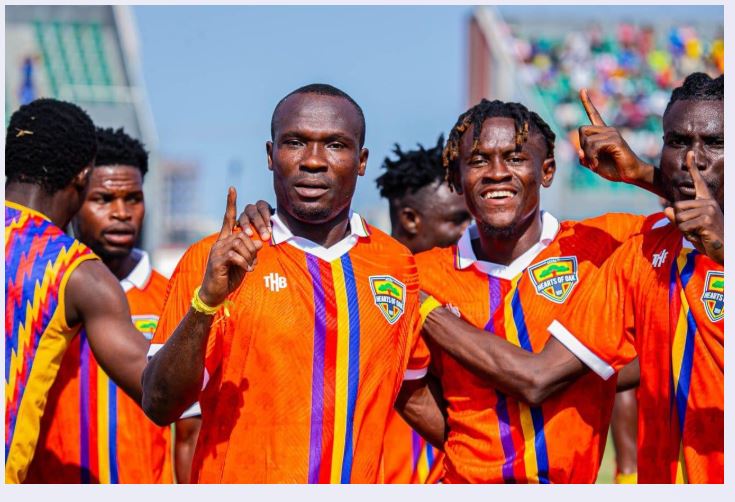
There were cases too where they suffered defeats as in the case of Basake Holy Stars who won their maiden Premier League game over Hearts in Accra.
Perhaps, it was the reason why the opening day win of the 2026/27 season was massively celebrated and considered historic because it came as a first opening victory in the last 10 years.
Pleasantly, the Phobians stormed one of the most difficult venues, that is, Bibiani where GoldStars have established themselves as tormentors; yet came out victorious to the surprise of many, including the staunch Phobian faithful.
Now celebrity goalkeeper, Benjamin Asare, whose performance in the penalty shoot-out loss to Asante Kotoko in Kumasi in the season-opening Democracy Cup match was questionable, made the Bibiani feat possible.
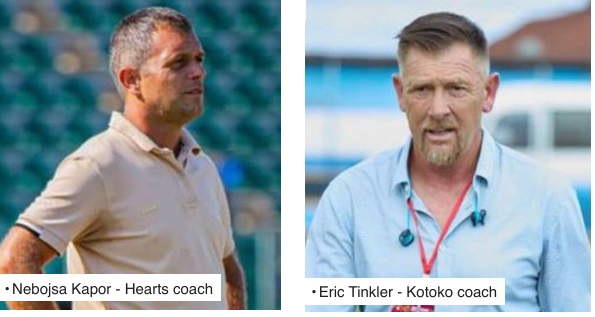
He proved his critics wrong by saving a late penalty awarded the home team to hand the Phobians a perfect run. Whatever Coach Bebojsa Kapor is doing with the Phobians seem to be attracting the applause from many quarters, but would what has been seen so far be enough to guarantee them the title this season?
Back to the University of Ghana Stadium in Accra, tomorrow, Hearts would seek to provide answers to those concerns when they welcome Bechem United in a third week Ghana Premier League (GPL) clash.
It would be one game that should attract quite a huge number of their followers to the stadium considering the team’s performance so far. Hearts remain one of just two clubs yet to drop a point. The other is FC Samartex, currently occupying second position with an inferior goal aggregate.
Bechem endured a torrid time in the previous season and survived the drop by a hair’s breadth. They appear to have done a good recruitment this season and are performing better than last season.
Again, Accra has been a difficult place for them although it has often provided some verve to attempt to upset the apple-cart.
But against a highly-spirited Hearts of Oak side inspired by a rejuvenated attack spearheaded by experienced striker John Antwi, Hearts would obviously be too strong for the visitors.
Former coach Didi Dramani’s replacement, Kapor appears to have discovered the team’s mojo, blending both new and old players to grind results that surpassed what were seen from them last season.
It may be early days yet but the urge of players to get the nod of the new manager, culminating in the competition for places in the first team seem to be driving the team to its desired direction.
So far, John Antwi has proven to be a great replacement for Mawuli Wayo who is currently playing in the Egyptian league.
Against Bechem, Hearts face a challenge to prove their doubters wrong by snatching all three points to not just keep the path of perfection but also, drum home the announcement that they are ready to be crowned as champions again.
FC Samartex face a challenge similar to that of the Phobians when they welcome Asante Kotoko at the Nsenkyire Sports Arena in Samreboi in what promises to be a fierce exchange.
Kotoko, just like the Phobians, have also altered the technical direction of the club, bringing in former South Africa international, Eric Tinkler whose first major achievement was the Democracy Cup win over their fierce rivals.
That game-though a glorified or over-hyped friendly, gave him a fair idea of what the fans’ expectations are and what the rivalry means to them.
Just like others, the Porcupine Warriors have done a very good recruitment this season to strengthen the team.
That has seen them annex four points from the two matches played so far.
Beating Heart of Lions last week came with great joy to their followers due to the bad record they have against them. The win, therefore speaks volumes about their intent for the season.
But engaging Samartex away would undoubtedly be a huge task they must confront with care. In the ‘absence’ of the giants, Samartex and other relatively new clubs have shown what they are made up.
It is, therefore understandable the caution with which the Porcupine Warriors are approaching the game. They stand as favourites although a Samartex shock for them would come with little surprise.
New entrants, Port City would engage Berekum Chelsea at the Nana Boamah Darko II Park in Kukurantumi, tomorrow.
The visitors gave an impression that they did not recover well from the previous season’s challenges that nearly got them relegated after losing massively to Hearts of Oak at the UG Stadium.
They, however recovered well to record a 3-1 victory in the second game to bag their first three points in the competition.
Coming up against Port City would be a game of equals but despite playing away, Chelsea must use their rich experience to at least earn a point.
The Nana Agyeman Badu II Park in Dormaa would be another exciting venue to be as Aduana FC welcome Karela United.
Another debutant, Debibi United FC would also host Young Apostles at the Debibi Presby Park while Dreams FC and Basake Holy Stars remain at home against GoldStars and FC AshantiGold, respectively at the Tuba Astro Turf and AAK II Arena, Basake.
Meanwhile, Vision FC and Heart of Lions are expected to kick off the weekend’s games today with dicey clashes against Medeama SC at the Nii Adjei Kraku II Sports Complex in Tema New Town and Swedru All Blacks at the Kpando Stadium.
By Andrew Nortey
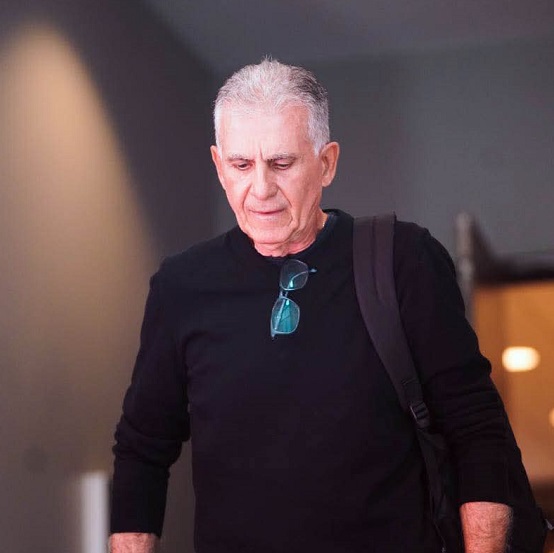
Black Stars head coach Carlos Queiroz says his immediate focus is securing qualification for the Africa Cup of Nations, while laying the foundation for a bigger dream building a Ghana side capable of honouring the nation’s legacy at the 2030 World Cup.
Speaking to the Ghana Football Association’s official website ahead of the AFCON qualifiers, the Portuguese tactician described the current moment as the start of a new cycle for the national team.
“Hands on the present, eyes on the future. The priority is very clear: absolute focus on AFCON qualification, with our eyes set on the 2030 World Cup,” Queiroz said.
“We have an immediate objective that demands our full concentration, but we also have a greater destination ahead of us. This is the moment to start building the team for 2030.”
The experienced coach, however, cautioned against premature title talk, insisting Ghana must first earn its place at the tournament.
“We must have ambition, but also humility. We know our recent history and we cannot talk about winning AFCON when we have not yet qualified. We have to work, grow, compete and earn our destiny,” he noted.
Queiroz was candid about where Ghana stands compared to Africa’s top sides, admitting that many of the continent’s leading teams have established squads with players featuring regularly in the UEFA Champions League.
“That is the competitive reality we must recognise and the level we must pursue,” he said.
Reflecting on the recent World Cup campaign, Queiroz said the experience was crucial for understanding the character and quality within the squad, adding that he is proud to lead “a fantastic group and a fantastic national-team culture.”
On squad selection, he explained that competitive form and physical readiness remain non-negotiable.
“There is always one general principle that we consider fundamental: players should be in competitive action, physically prepared and fully ready to play for the national team,” Queiroz stressed.
He concluded with a message of hard work and humility, urging the team to outwork the best on the continent if Ghana is to achieve its ambitions.
“Every squad selection, every training session and every match must contribute to building a better team. If we want to compete with the best, it is not enough to work as hard as they do. We have to work even harder and better,” he concluded.
By Edem Mensah-Tsotorme

 Entertainment1 week ago
Rhythms On Da Runway returns November 28 with 16th edition themed ‘Unbound’
- News1 week ago
48 Engineer Regiment to be major sub-contractor on Accra-Kumasi Expressway, $2bn ready- Prez Mahama
- Entertainment1 week ago
Ohemaa Mercy’s Tehillah Experience outfit was priestly regalia, not costume – Management clarifies