News
Ghanaian Scientist Uses Math to Tackle Food Safety Risks in Online Food Delivery Era


- /home/u249204778/domains/spectator.com.gh/public_html/wp-content/plugins/mvp-social-buttons/mvp-social-buttons.php on line 27
https://spectator.com.gh/wp-content/uploads/2025/06/IMG-20250604-WA0015.jpg&description=Ghanaian Scientist Uses Math to Tackle Food Safety Risks in Online Food Delivery Era', 'pinterestShare', 'width=750,height=350'); return false;" title="Pin This Post">
- Share
- Tweet /home/u249204778/domains/spectator.com.gh/public_html/wp-content/plugins/mvp-social-buttons/mvp-social-buttons.php on line 72
https://spectator.com.gh/wp-content/uploads/2025/06/IMG-20250604-WA0015.jpg&description=Ghanaian Scientist Uses Math to Tackle Food Safety Risks in Online Food Delivery Era', 'pinterestShare', 'width=750,height=350'); return false;" title="Pin This Post">
Emmanuel Addai, a Ghanaian Ph.D. researcher specializing in Mathematical and Data-driven Modeling of infectious disease and cyber forensics at the University of Arkansas at Little Rock, has co-authored a pioneering study that reveals how the rapid growth of online food delivery services is fueling the spread of food-borne illnesses.
In the peer-reviewed article, Addai and his collaborators developed a mathematical model that incorporates both human and insect populations (particularly flies) to simulate how food safety is compromised during doorstep food deliveries.
The model uniquely uses fractional calculus (Caputo operator) to reflect real-world memory effects such as poor hygiene practices and delayed policy responses.
The study shows that:
• Asymptomatic carriers, delivery personnel, and flies are critical transmission vectors.
• Government interventions such as food safety training for restaurant staff and stricter hygiene enforcement can significantly reduce outbreaks without disrupting food delivery services.
• The model was proven stable and accurate under rigorous mathematical conditions and tested using numerical simulations in MATLAB.
By integrating public health, data science, and mathematical modeling, Addai’s work provides a policy-ready framework for managing infectious outbreaks in urban food systems.
This research aligns with global food safety goals and supports the UN Sustainable Development Goals (SDG 3, 11, and 12).
For Ghana and beyond, this research underscores the urgent need for better regulation, monitoring, and public health oversight of digital food platforms, particularly in rapidly urbanizing and densely populated cities.
As the online food delivery industry continues to grow, especially in emerging economies such as Ghana, Nigeria, Kenya, and India, the lack of standardized food safety protocols and oversight for delivery chains has emerged as a major public health risk.
Emmanuel Addai’s research provides an evidence-based mathematical framework for policymakers to anticipate and manage these risks through optimal interventions.
This work is particularly impactful for developing nations, where informal food vendors and under-regulated delivery systems often operate outside the scope of national health standards.
His model can be adapted to simulate various real-world conditions urban slums, peri-urban hubs, and even cross-border trade routes, allowing government agencies and health departments to simulate outbreak scenarios, prioritize inspection strategies, and develop early-warning systems.
Furthermore, Addai’s contribution supports Ghana’s national priorities under the Ghana Food Safety Policy and aligns with UN Sustainable Development Goals (SDGs), especially:
• SDG 3: Good health and well-being,
• SDG 11: Sustainable cities and communities,
• SDG 12: Responsible consumption and production.
Ultimately, Emmanuel Addai’s contribution stands as a critical bridge between theoretical science and practical policy application, enabling stakeholders to make data-driven decisions in regulating the fast-growing online food delivery ecosystem.
This makes his research not only nationally important to Ghana’s public health strategy but also internationally recognized as a novel methodology applicable in both low- and high-income settings.
ByJulius Kofi Satsi







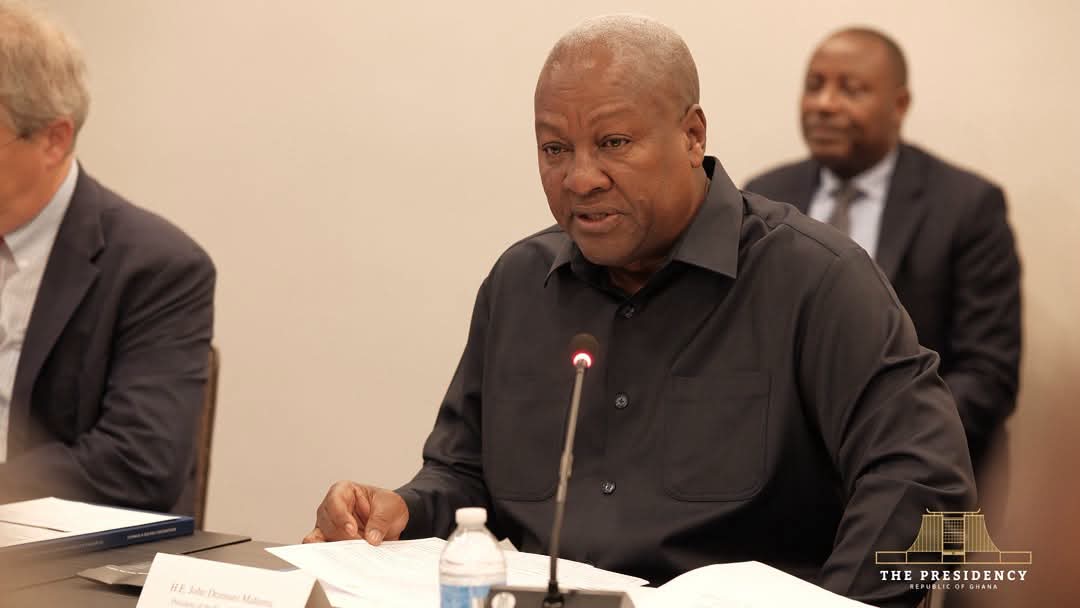
President John Dramani Mahama has called for stronger domestic capacity, effective institutions and sustainable financing as countries in the Global South continue to face growing debt pressures and disruptions in the international development landscape.
Speaking at a Presidential Roundtable organized by the Open Society Foundation in New York on Monday, on the sidelines of the 81st UN General Assembly, President Mahama said the priority for developing nations must be to create jobs, improve public services, build infrastructure and expand opportunities, particularly for young people.
“When I speak about sovereignty in this context, I am speaking about the capacity to act,” President Mahama stated.
He further stressed the need for stronger coordination across government, greater domestic resource mobilisation, sound financial management and institutions capable of delivering measurable results.
“Where an approach proves successful, the next step should be its adoption into public systems, local delivery institutions, and long-term financing models,” he added.
The high-level roundtable brought together presidents and chief executives of major global foundations to discuss sustainable development, financing and strengthening institutions across the Global South.
By Edem Mensah-Tsotorme
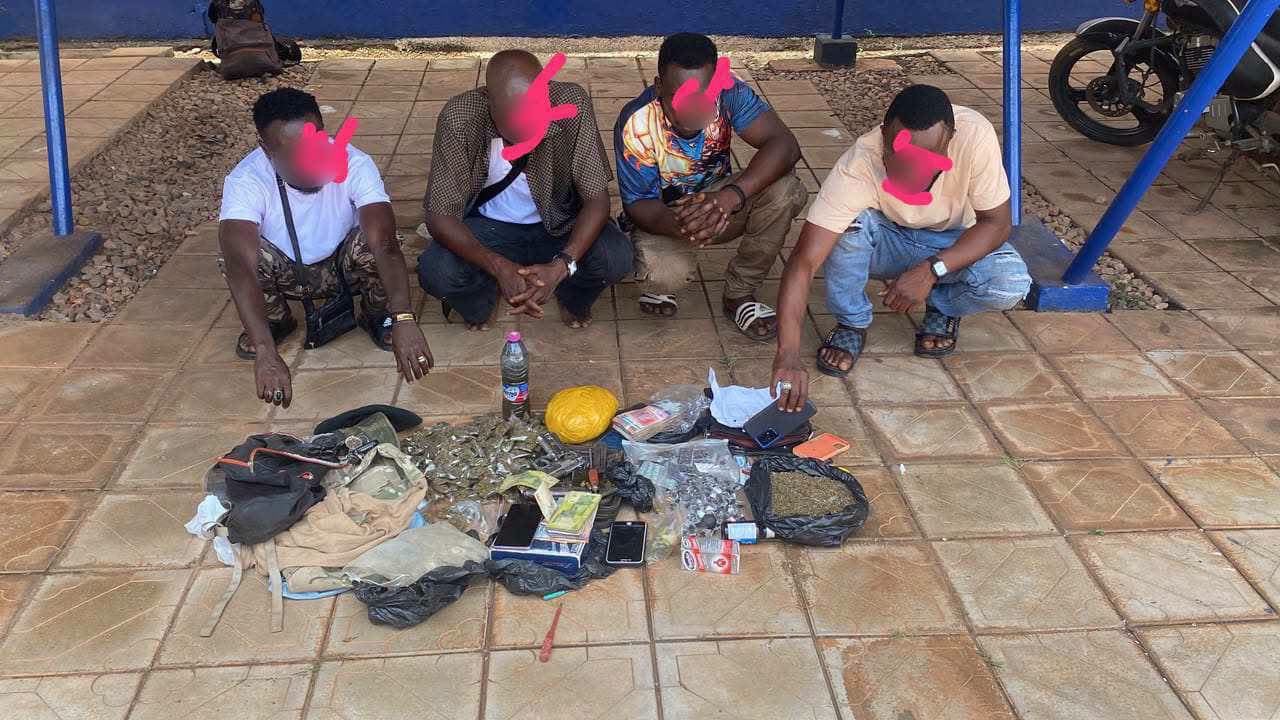
The Northern Regional Police Command has arrested five people during an operation at the Aboabo scraps area in Tamale, where two pistols, ammunition, suspected narcotics and cash were recovered.
The operation was carried out on Monday, September 21, 2026, at about 11:30 a.m. by the Special Operations Team, known as RED MARIA, as part of efforts to clamp down on drug peddling, drug use and other criminal activities in the Tamale Metropolis.
According to the police, the team acted on credible information and proceeded to the Aboabo scraps area, near the forest, where they arrested five suspects.
They were identified as Ibrahim Issahaku, 39; Mohammed John, 28; Mohammed Nawas, 25; Mohammed Osman Awal, 41; and Kwame Boateng, 28.
The police said a search at the residence of Ibrahim Issahaku led to the recovery of two foreign made pistols, two rounds of 9mm ammunition, one parcel of suspected Indian hemp and GH¢1,880 in cash.
The police also found GH¢18,825 concealed inside the motorcycle of Kwame Boateng at the ghetto. The money is suspected to be proceeds from the sale of narcotic drugs.
Other items recovered included 123 wraps of suspected Indian hemp, 12 sachets of 1mg Rohypnol, seven sachets of 250mg Tramadol, 111 wraps of suspected ashes and three motorbikes.
In a statement issued on Tuesday, September 22, 2026, the Northern Regional Police Commander, DCOP Wisdom Lavoe, said the suspects and the exhibits had been handed over to the Regional Drug Law Enforcement Unit for further investigation and the necessary action.
He added that the Regional Command would continue to conduct intelligence led operations to disrupt drug related activities and other criminal activities in the region.
By: Jacob Aggrey

 Entertainment1 week ago
Rhythms On Da Runway returns November 28 with 16th edition themed ‘Unbound’
- News1 week ago
48 Engineer Regiment to be major sub-contractor on Accra-Kumasi Expressway, $2bn ready- Prez Mahama
- Entertainment1 week ago
Ohemaa Mercy’s Tehillah Experience outfit was priestly regalia, not costume – Management clarifies