Hot!
COVID-19 Levy: Nuisance or prospect for funding public health emergencies?


- /home/u249204778/domains/spectator.com.gh/public_html/wp-content/plugins/mvp-social-buttons/mvp-social-buttons.php on line 27
https://spectator.com.gh/wp-content/uploads/2023/06/Covid-levy1.jpg&description=COVID-19 Levy: Nuisance or prospect for funding public health emergencies?', 'pinterestShare', 'width=750,height=350'); return false;" title="Pin This Post">
- Share
- Tweet /home/u249204778/domains/spectator.com.gh/public_html/wp-content/plugins/mvp-social-buttons/mvp-social-buttons.php on line 72
https://spectator.com.gh/wp-content/uploads/2023/06/Covid-levy1.jpg&description=COVID-19 Levy: Nuisance or prospect for funding public health emergencies?', 'pinterestShare', 'width=750,height=350'); return false;" title="Pin This Post">
On 31st March 2021, President Akufo Addo approved the Covid-19 Health Recovery Levy Act, 2021 (Act 1068). As the name suggests, the levy was deemed necessary due to ‘unexpected’ expenses incurred by the government as a result of the devastating effects of COVID-19.
The levy, which became effective 1st May 2021, is two years old this year but one cannot tell the exact life span of this tax which some people consider “a nuisance.” Meanwhile, there seems to be split opinion on whether the levy should remain or be scrapped completely.
Opinions
Arguments supporting the scrapping of the levy now appear more legitimate following recent announcement by the World Health Organisation that COVID-19 was no longer a public health emergency.
Organisations such as IMANI Ghana, Importers and Exporters Association of Ghana (IEAG), the National Democratic Congress (NDC) and the Convention People’s Party (CPP), all agree that the levy has outlived its intended purpose and should, therefore, not remain a burden on citizens.
The Vice President of IMANI Africa, Kofi Bentil, for instance, believes “continuous implementation of the levy reduces the trust people have in the government.” For him, the incidence of COVID-19 in the country was not as serious as it was in other countries; therefore, it was “problematic” to continue paying for “freebies” such as food, water and electricity which were provided to some citizens at the height of the pandemic.
The Importers and Exporters Association of Ghana also made a similar argument in November last year when it called for the removal of “nuisance taxes” a few days before the Finance Minister presented the 2023 Budget and Economic Policy Statement.
According to the association’s General Secretary, Mr. Samson Asaki Awingobit, the COVID-19 levy in addition to other taxes made the cost of doing business in Ghana expensive. He, like other critics, doubted how soon the tax would be removed.
The National Communications Officer of the National Democratic Congress (NDC), Mr. Sammy Gyamfi addressing a press conference in August 2022, described the COVID-19 Levy as “offensive and punitive.”
He was convinced that the government had been “insensitive to the plight of Ghanaians at a time when other nations were cushioning their citizens against the impact of the pandemic.”
“Nowhere in the sub-region or in the African continent and, I dare say, the world has any government imposed a COVID levy on its people. And at no point in the history of this country has any government imposed a tax handle for the management of any disease on the Ghanaian people,” Mr Gyamfi said in his address.
Other perspectives
An interesting perspective regarding the scrapping of the levy was that of the Convention People’s Party (CPP) which suggested that the government use proceeds from the COVID-19 levy to support utility service providers (Ghana Water Company and the Electricity Company of Ghana) who were demanding an increase in utility tariffs.
Unlike these organisations, a coalition of Civil Society Organisations (CSOs) and academia proposes that the levy should be maintained, and redirected to addressing existing challenges in the health sector and a separate account established for it.
The CSOs believe the current arrangement, where the contributions are paid into the Consolidated Fund, made it difficult to independently track revenue accrued from the levy. One cannot agree more with this position considering that citizens may probably have to wait until the Finance Ministry announces or renders an account of the fund in its Budget and Economic Policy Statement.
Purpose
Proponents of the COVID-19 Levy say the fund is intended to mobilize additional revenue to employ more health workers at the country’s health facilities, build new health facilities, and finance the deployment of COVID-19 vaccines across the country.
It again seeks, among other things, to support the establishment of 14 medical waste treatment facilities across the country for the safe disposal of medical waste in collaboration with the private sector.
These objectives notwithstanding, it is time the government took a second look at alternative and judicious applications of the COVID-19 levy, renaming and demarcating it as a levy to fight future pandemics.
It is clear that successive governments have an insatiable appetite for tax and the collection of taxes including the COVID-19 levy may not cease, especially when there is no “sunset clause”(expiry date) in the law that established the levy.
As it stands, one cannot put an exact figure to how much income had been generated from the levy. It may only take the intervention of Members of Parliament who would send a special invitation to the Finance Minister to provide details of the levy and how it had been expended in the last two years.
While that is being done, it would be appropriate to take a critical look at proposals put forward by organisations calling for accountability and sustainable use of the COVID-19 fund.
Conclusion
Although organisations such as the Ghana Medical Association are yet to indicate their stance on the COVID-19 Levy, other health experts and social commentators agree that the levy be renamed and redirected to funding health emergencies in the country.
The establishment of a Public Health Emergency Fund, as indicated previously, would help the country effectively tackle health-related emergencies, and in the long run fund Ghana’s public health care system which is overly reliant on external donors in addressing health needs.
In times of health crises, communication, health promotion, disease surveillance, among others would require prompt and adequate funding. This is one of the reasons we cannot afford to scrap the COVID-19 Levy entirely. It should rather be seen as an opportunity to augment the meager sources of revenue that are used to support recurring public expenses.
While we look forward to this happening in the shortest possible time, we must continue to ensure prudent management of the fund even after it is amended and renamed as a Public Health Emergency fund.
By Ernest Nutsugah


The Tema Regional Police Command has arrested a 32-year-old man for allegedly posing as a soldier and extorting money from unsuspecting members of the public at Ashaiman.
The suspect, identified as Bright Atsu Kudiabor, was arrested by the Ashaiman Police on Wednesday, September 16, 2026, at about 7:00 a.m.
According to the Police, he was arrested at an area known as “I Shall Return”, where he was allegedly parading himself as a soldier and demanding money from people.
The Police said Kudiabor, who is an ex-convict, was initially arrested by personnel of the Ghana National Fire Service in Ashaiman with assistance from other members of the public.
A search conducted on him after he was handed over to the Police reportedly led to the recovery of a set of military camouflage uniform.
The suspect is currently in Police custody and assisting with investigations.
The Tema Regional Police Command said he would be processed for court after investigations are completed.
The Police urged the public to remain vigilant and report anyone who falsely presents themselves as a soldier or a member of another security agency to deceive or extort money from the public.
By: Jacob Aggrey
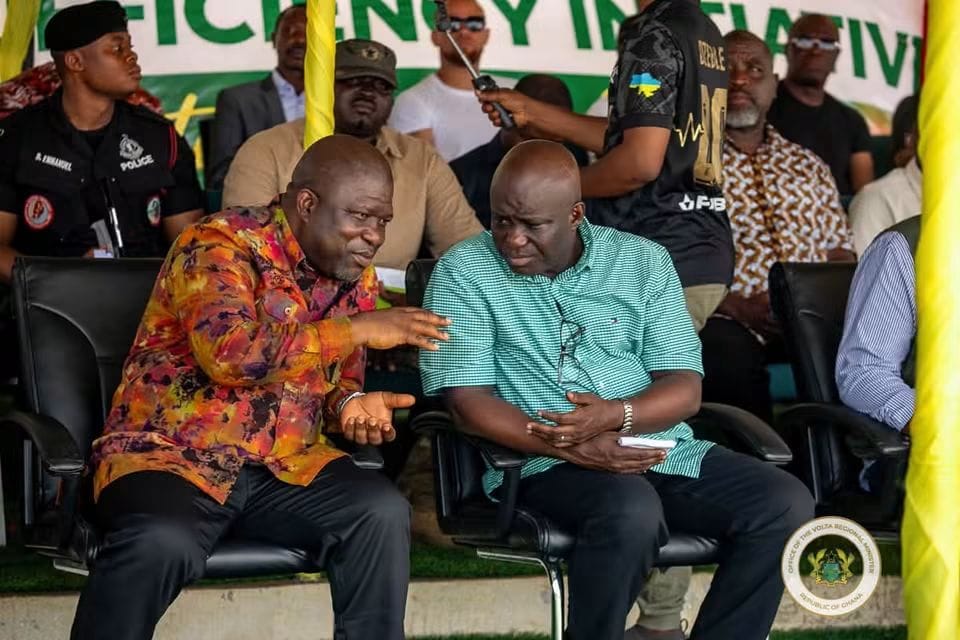
Volta Regional Minister, James Gunu, says the Volta Region holds enormous agricultural potential and efforts must be geared towards connecting farmers to the needed resources to unlock that potential.
He said focus must be on linking farmers to resources, technology, financing and markets to increase production, create jobs and build sustainable livelihoods.
Hon. Gunu made the remarks at the national launch of the Ghana Tomato Self-Sufficiency Initiative (GHATSI) held at Anloga in the Volta Region on Tuesday, September 15.
The initiative, under the theme “Produce at Home. Feed the Nation. Export the Surplus,” seeks to boost local tomato production, processing and marketing while reducing Ghana’s heavy reliance on imported tomatoes.
The launch was attended by the Minister for Food and Agriculture, Eric Opoku, his Deputy, John Setor Dumelo, Feed Ghana Coordinator, Bright Demordzi, Members of Parliament, traditional leaders, MMDCEs, farmers and other stakeholders.
Mr.Gunu expressed appreciation to the Minister for Food and Agriculture for the support announced for the region, including two excavators, 200 cartons of organic fertiliser, and GH¢200,000 for Ms. Kuatudzo Esther Dela, a tomato farmer and processor from Ziope.
He described the initiative as an important step towards making agriculture a stronger driver of food security, job creation and economic growth in the Volta Region.
By Edem Mensah-Tsotorme

 Entertainment1 week ago
Rhythms On Da Runway returns November 28 with 16th edition themed ‘Unbound’
- News1 week ago
48 Engineer Regiment to be major sub-contractor on Accra-Kumasi Expressway, $2bn ready- Prez Mahama
- Entertainment1 week ago
Ohemaa Mercy’s Tehillah Experience outfit was priestly regalia, not costume – Management clarifies