Entertainment
Amb. Prince Kojo-Hilton’s international mission signals new era for creative industry development

Between October 2025 and April 2026, a significant creative industry mission unfolded across Brazil, led by Ghanaian visual artist, production designer, and Pan-African Art Ambassador, Prince Kojo-Hilton.
What began as an invitation to contribute to creative education quickly evolved into a far-reaching engagement spanning academic institutions, government bodies, global platforms, and community initiatives.

More than a professional visit, the mission positioned itself as a structured intervention aimed at addressing one of the most pressing gaps within the global creative sector, the disconnect between education and industry practice.
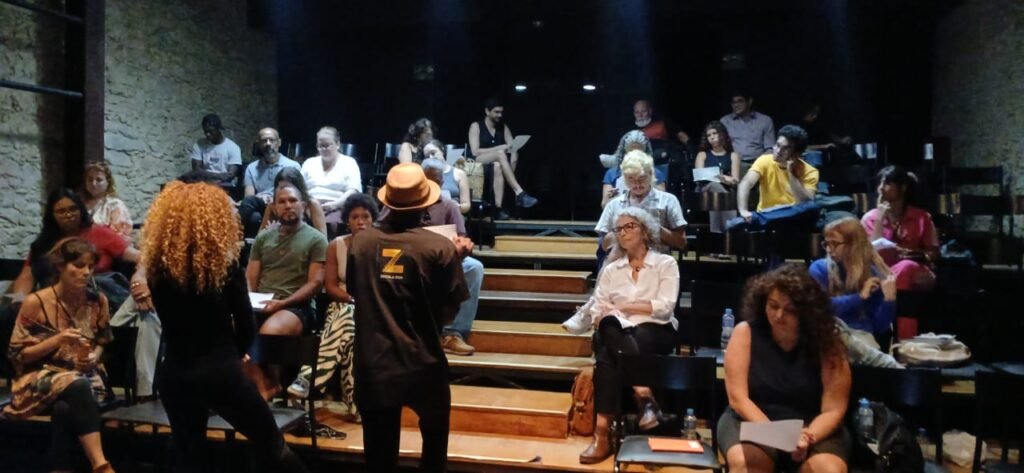
At the centre of this engagement was a clear focus on capacity building. Working with the Zion School of Entertainment in Rio de Janeiro, Kojo-Hilton delivered a masterclass in Art Direction and Scenic Design during Zion Creative Week.
The immediate impact of the session prompted an expansion of the masterclass programme into a broader, multi-campus engagement, extending its reach to a wide network of students and emerging professionals.


His approach departed from traditional classroom instruction. Instead of theory-driven lectures, participants were introduced to practical, industry-based processes, including visual storytelling systems, production design methodologies, and the professional discipline required to operate within global creative industries.
The result was a shift in how students engaged with their craft, moving from passive learning to active, experience-driven development.
Beyond academic institutions, the mission extended into diplomatic and governmental spaces. At the Ghana Embassy in Brazil in Brasília, Kojo-Hilton engaged in strategic discussions with Ghana’s Ambassador to Brazil, Nii Amasah Namoale.
The discussions centered on long-term collaboration between Ghana and Brazil within the creative arts sector, with a focus on education, exchange programmess, and institutional partnerships.
This engagement progressed further at the National Congress of Brazil, where he was introduced to policymakers and cultural leaders, including Brazil’s Minister of Culture, Margareth Menezes.
His presence and work were formally acknowledged, reflecting growing recognition of the role creative professionals can play in national development and cultural diplomacy.
On the global stage, Kojo-Hilton represented Ghana at the World Forum of Favelas 2025, where his contributions to creative community development were recognised with an international award.
The forum provided a platform to present models that integrate art, education, and social impact, reinforcing the value of structured creative initiatives in community transformation.
A key outcome of the mission was the international expansion of the Film Craft Expo, an initiative founded by Kojo-Hilton to explore the art, science, and business of film-making and theatre.
Interest from multiple countries has positioned the platform as a potential global model for creative industry engagement, bridging the gap between emerging talent and professional practice.
Academic collaborations also formed a critical component of the mission.
At the University of Brasília, discussions explored interdisciplinary opportunities connecting art, science, and environmental innovation. Additional engagements with institutions such as Casa das Artes de Laranjeiras focused on curriculum development, artist residencies, and production-based training systems designed to better prepare students for industry demands.
While institutional engagement remained central, the mission maintained a strong connection to community impact. Workshops conducted in local communities, including Maricá, emphasised the role of art as a tool for empowerment, identity formation, and social transformation.
A significant part of his engagement in Maricá included a cultural and social contribution through the donation of a painting to the House of Immigrants.
The artwork serves as a permanent symbolic gesture of identity, resilience, and shared human experience, reflecting his commitment to using art as a tool for cultural connection and community memory within the city.
Participation in cultural events such as Rio Carnival further highlighted the importance of preserving cultural heritage while positioning it within a global context.
One of the most forward-looking outcomes of the mission is the development of the Global Visual Arts for Screen and Stage initiative.
The platform is designed to integrate visual arts, film, theatre, fashion, and technology into a unified system that supports training, collaboration, and industry growth.
By addressing fragmentation within the creative sector, the initiative aims to create sustainable pathways for employment, innovation, and institutional development.
Across all engagements, a consistent message emerged, the global creative industry is evolving, and there is an increasing demand for structured, experience-driven education.
Institutions are no longer seeking inspiration alone; they are seeking systems that can translate creativity into measurable economic and social impact.
Following six months of sustained engagement across Brazil, the results are evident. New partnerships are being explored, institutions are opening pathways for collaboration, and there is growing recognition of the role creative industries can play in national and international development.
The mission has not only strengthened cultural and creative ties between Ghana and Brazil, but has also positioned Kojo-Hilton within a broader global conversation on the future of creative industry development.
As he continues to expand his work across continents, he remains open to collaboration with universities, film schools, theatre institutions, visual arts institutions, cultural organizations, and governments seeking to invest in structured creative growth.
He also facilitated a focused workshop on Talent Discovery and Nurturing with immigrants, centered on identifying hidden creative potential and providing practical guidance for personal and professional development.
The session emphasised empowerment through creativity, encouraging participants to recognise their abilities and explore new pathways within the creative industries.
Together, these contributions reinforced his broader mission of using art not only as a professional practice but as a meaningful instrument for inclusion, transformation, and social impact.
In reflection, he expresses profound gratitude to God for the opportunity to undertake this journey and for the grace that made every step possible. From Ghana to Brazil and back, he acknowledges the divine protection, guidance, and favour that ensured safe travels and the mission’s successful execution.
The experience stands not only as a professional milestone but also as a testament to the power of faith, dedication, and purpose.
His guiding philosophy remains clear and unwavering, saying “The only thing that I am a slave to is my passion.”
By Edem Mensah-Tsotorme